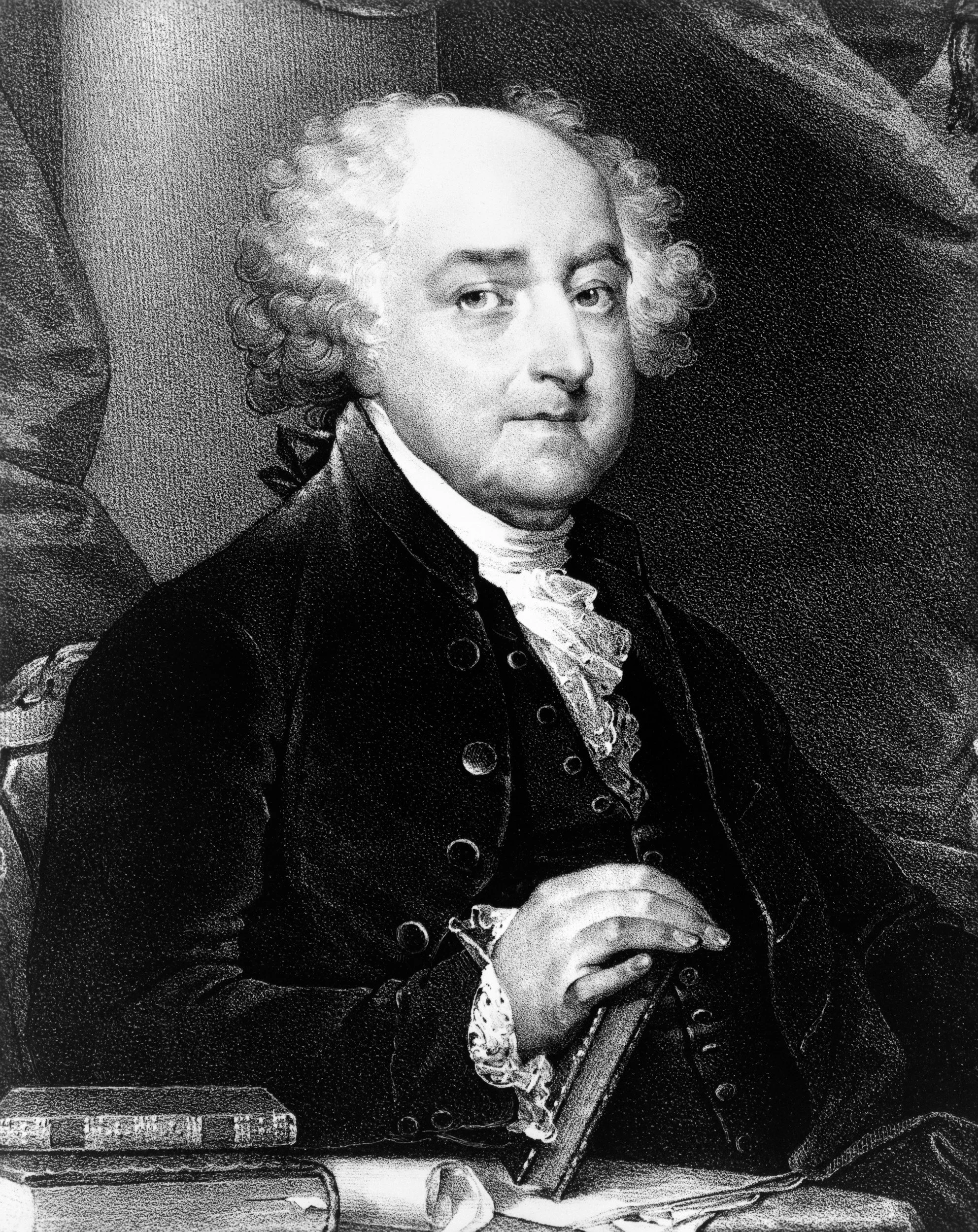
John Adams | "I Know I Am Right"
It is the most famous painting ever done by an American…John Trumbull’s signing of the Declaration of Independence on July 4, 1776. And almost everything about it is inaccurate. The room didn’t look like the room is portrayed. The curtains and the windows are not the same. The furniture is wrong, the doors are in the wrong place. The Declaration of Independence was not signed on the fourth of July 1776. They didn’t begin signing it until August of 1776 and not everyone was present for the signing…But there is one thing about it that’s entirely accurate, and those are the faces of the people portrayed…If you study the painting, you’ll notice that all the lines of perspective all come down to the three characters in the foreground: John Adams, Thomas Jefferson, and Benjamin Franklin. John Adams was not the author of the Declaration of Independence; he chose the author of the Declaration of Independence…If Jefferson was the pen, Adams was the voice.
- David McCullough, address to the John Adams Society, September 2004 -
If the world was ending and I could have only one book in my bomb shelter apart from the Bible, it would be David McCullough’s biography of John Adams. This work is a stellar bit of historical scholarship and, just as important, a masterpiece of storytelling. I had the privilege of learning from Mr. McCullough at Hillsdale College in 2004 and was spellbound by his lectures about our second president. So if you take nothing else from this episode, find a copy of John Adams—a physical copy—and add it to your own bomb shelter library.
In the popular mind, John Adams’ life and one term as President of the United States is often treated as a footnote alongside the careers of Franklin, Jefferson, and Washington. He was not a diplomat by training or attitude; he tended to offend others by his bluntness. His approach to politics and controversy was bold yet bull-headed. He famously said in a letter to a colleague, “Thanks be to God that He gave me stubbornness when I know I am right.” He thus made few friends in public life and ended up losing an election and retiring into quiet obscurity. But John Adams left an indelible mark on his country’s history, one that I cannot even approach in fifteen minutes. So as we continue our look into the revolutionary period, I want to share three elements from Adams’ life that, I believe, capture the essence of this fascinating man.
“Facts are Stubborn Things”
Word spread across British America of tragic events in Boston. On March 5, 1770, a mob of colonists had assaulted a British sentry outside the town’s custom house. Amidst shouts of “Kill them!” and “Knock them down!” shots rang out, and five Americans fell. Within days, the anti-tax protest group known as the Sons of Liberty were telling stories of the massacre in Boston. The soldiers and their commander, Captain Thomas Preston, were to be tried in a Massachusetts court. Public opinion demanded hard and immediate punishment, but Governor Hutchinson insisted on a fair proceeding first. After several Loyalist attorneys refused the case, the governor recruited John Adams to represent the accused.
Adams had been a lawyer since graduating from Harvard College and was well-versed in the law. Bostonians knew he opposed parliamentary taxation, but he lacked the radical zeal of his cousin Samuel. His preparation for the trial included interviewing the soldiers, finding witnesses who would testify, and a great deal of talking with Abigail, his wife, dearest friend, and closest confidante. The trial opened with testimony from eyewitnesses who insisted that the crowd had merely hurled some insults and a few snowballs, nothing more. The hostile courtroom audience jeered whenever Adams asked a question they disliked, but the jury (made up of Massachusetts men) listened as he slowly exposed the truth. The mob had carried clubs and thrown rocks, oyster shells, and pieces of ice—one of which had left a bad cut over a soldier’s eye. His witnesses described the hate that twisted the rioters’ faces; when one told the court that he’d heard someone in the crowd yell “Fire, fire if you dare,” the jury was convinced. The court found two soldiers guilty of manslaughter since they’d feared for their lives; the rest were innocent. Adams breathed a sigh of relief at his victory, said a few words to Preston and the others, then left the courthouse.
Adams’ law practice, as well as his public reputation, suffered briefly after the trial, but he comforted himself at having done the right thing. British soldiers, the most unpopular men in all of Massachusetts, had received a fair trial despite a massive outcry. He had shown his countrymen—not to mention British authorities—that the law and not the passions of a mob ruled in America. As those passions faded, his reputation and law practice recovered, and he was elected to the colonial assembly. Three years later, after the Boston Tea Party, the British imposed a series of legal punishments for that public disturbance. Outrage filled Adams’ heart when he heard that British soldiers, officers, and magistrates accused of crimes in Massachusetts would be brought back to London for a trial. Hadn’t the colonists, hadn’t he personally proven that they would be treated fairly in Boston? It was likely this moment that started Adams down the road that eventually took him to Philadelphia.
“Jefferson Lives”
Massachusetts and Virginia may as well have been different countries in 1775 (as they indeed were until the 1781 Articles of Confederation united the thirteen states). The former was poor and small, the latter rich and large. Their delegates came from different worlds, but John Adams soon found kindred souls in two Virginians. As Congress debated helping the Massachusetts militia once war broke out at Lexington and Concord, he proposed the appointment of the tall, stately figure of George Washington as the army’s commander-in-chief. Far deeper was his friendship with Thomas Jefferson, the man whom David McCullough said was the pen to Adams’ voice in the summer of 1776. The pair worked with Benjamin Franklin and two other delegates to write the Declaration of Independence. Adams knew that its author had to come from the largest colony, and Jefferson’s quiet fury at British tyranny was, he believed, perfect for the moment. As Congress considered Jefferson’s declaration in July, Adams certainly had his friend’s eloquent words in mind when he opened the debate:
Objects of the most stupendous magnitude, measures in which the lives and liberties of millions, born and unborn, are most essentially interested, are now before us. We are in the very midst of revolution, the most complete, unexpected, and remarkable of any in the history of the world.
Nine years later, with the revolution complete and victory won, Adams reunited with his friend in Paris. Jefferson would succeed the aging Benjamin Franklin as ambassador while Adams prepared to depart for London. The two, together with Abigail, spent weeks discussing America’s uncertain future in the world and, Adams’ diary records, talking about the nature of man and government. Jefferson’s idealism of a decade earlier remained intact while Adams’ had diminished with experience in France. John had grown wary of popular government that broke with past traditions, while Thomas was eager to see, as he put it, the tree of liberty “watered with the blood of patriots and tyrants.”
French trees soon dripped with blood, but no liberty flowered in their sodden branches. Despite Jefferson’s efforts to inspire French radicals, that revolution burned away one tyranny and built others in its place. In London, Adams read the news across the English Channel with mounting horror and fear for his friend’s safety. When both returned home as America’s first presidential election drew near, Abigail wrote her husband that she found Jefferson “much changed” over the years.
Political differences drove the two friends apart over questions of foreign policy that we will come to shortly. After the bitter election of 1800 that saw Jefferson succeed Adams, the two did not speak or correspond for years. Only when age began to dim their eyes did they resume a written relationship. Jefferson mourned Abigail’s passing in 1818 and celebrated John’s son John Quincy’s election to the presidency six years later. The letters that survive are filled with both historical insight and personal anecdotes that show the two men had put the past behind them. On July 4, 1826, as the United States celebrated its fiftieth birthday, both men passed away peacefully. Adams’ final words from his bed at Peacefield were, “Jefferson lives,” not knowing that his friend and rival of five decades had died hours earlier at Monticello.
“Trust No Man Living”
John Adams came second to George Washington in the 1788 presidential election, earning him the position of Vice President of the United States. He found the job immensely difficult and, also, terribly boring. Constitutionally, his only two tasks were to have a heartbeat and break ties in the Senate, over which he presided but to which he could not speak. If ever he was at the President’s House in Philadelphia, Washington would dismiss him from the room if the Cabinet wished to discuss government business. Adams thus played no role in affairs that threatened the future of the nation he’d helped create.
With Great Britain and France at war, both nations preyed on American shipping to take sailors and cargo for their militaries. Secretary of State Thomas Jefferson insisted the United States support its old ally France in the revolutionary wars, while Treasury Secretary Alexander Hamilton, a scheming but brilliant creature of New York politics, urged Washington to preserve American trade by aiding Britain. The president instead chose neutrality, which irritated both Cabinet officers, and when he left office after two terms, each politician hoped to outmaneuver the other by influencing the new chief executive.
John Adams retained Washington’s Cabinet on assuming office in 1797, which meant he was surrounded by Hamilton’s supporters. Instead of following his predecessor’s example of keeping quiet, Vice President Jefferson battled Hamilton’s Federalists in the press and caused his former friend no end of headaches. War fever gripped the nation with half of the population demanding war with one great European rival or the other. When French ships attacked several American merchant vessels in 1797, Hamilton’s men in the Cabinet demanded action. Diplomatic insults followed, and Jefferson’s press howled that Adams was a warmonger for arming U.S. ships at sea and readying the army for war. The president then let a personal flaw overwhelm his good judgment. Attacked on all sides in speeches and newspapers, Adams signed a Federalist bill called the Sedition Act and made it a crime to utter any statement against the government that was “false, scandalous and malicious.”
When reading John Adams’ letters to Abigail, one finds that he often apologized for his “vanity” after asking her to approve of his thoughts or deeds. Scholars agree that he suffered from very low self-esteem and craved others’ approval. (His contributions to American history should, in my view, have been more than enough to satisfy such vanity, but such are the flaws of even great men.) Adams had endured character attacks in the press for decades, and it appears that the stresses of office and trying to keep the United States out of a disastrous war simply caused him to snap. The Sedition Act blatantly contradicted the First Amendment to the Constitution and permanently marred his legacy to free-speech advocates.
In November 1800, as Congress remained deadlocked between Jefferson and Aaron Burr as Adams’ successor, the president received a letter from his son. As a boy, John Quincy had accompanied his father to France and begun his diplomatic career as a translator in the imperial Russian court at only fourteen years of age. Now he was America’s emissary to Consul Napoleon Bonaparte of France. Seated by a fire in the newly-built White House, President Adams read that Bonaparte had declared that tensions with America were merely a “family quarrel.” So Adams had been right yet again. Despite all the anger, all the turmoil, at least his tombstone could read that he had achieved peace with France before leaving office.
“Posterity”
There is so much more to say about John Adams. For those of you begging me to discuss his relationship with Abigail, the couple’s views on slavery, or how they raised their children, please tune in next week—Joe will no doubt bring up each of those topics. Let me conclude with two pieces of wisdom from our second president that, I think, speak to Americans today. John Adams was the first president to live in the White House; shortly after he took up residence, he wrote to his wife: “I pray Heaven to bestow the best of blessings on this House and all that shall hereafter inhabit it. May none but honest and wise men ever rule under this roof.” And second, from a letter to Abigail while he was serving in France during the Revolution: “Posterity! You will never know how much it cost the present generation to preserve your freedom. I hope you will make a good use of it. If you do not, I shall repent in Heaven that I ever took half the pains to preserve it.”