Sketches in History | Don't Give Up the Ship
Hello, and welcome back to Sketches in History! I’m Lottie Archer, your guide. Every week, we sit together in my grandfather’s study and open my magical notebook to a sketch from history, letting it pull us into the past to experience a moment first-hand. Last time, we witnessed one of the first peaceful transfers of power in American history. I can’t wait to see where we go today!
The fire is burning low tonight, and the smell of old books and pinewood fills the room. I light a small lamp near the mantelpiece and notice something resting beside an old compass: a piece of dark blue cloth, folded neatly inside a wooden box.
When I unfold the fabric, I see white letters stitched carefully across the center. They spell out a message: “Don’t Give Up the Ship.” The cloth is worn and moves against the heat coming from the fireplace, almost as if it remembers the wind that once filled it. I bet this flag has an amazing story, and I can’t wait to open the notebook so we can experience it together!
But before we open the notebook, let’s learn our Word of the Day: Courage.
Remember how you felt the first time you rode your bike, jumped in the pool for the first time, or tried something new? You probably felt afraid in that moment, but you decided to do what you were afraid of anyway. That’s how we define courage. Courage means doing something brave even when you’re scared. It doesn’t mean you’re fearless — it means you face your fear anyway, because the right thing to do is worth it.
Alright, let’s see what the notebook has to show us. The sketch this time shows a gray morning over a wide lake. Ships line the horizon, their sails straining in the wind. In the center of the drawing stands a young man in a blue naval coat, his sword raised high, and above him, flying proudly, is that same blue flag with the words “Don’t Give Up the Ship.” The water on the page is starting to ripple. The sails begin to move.
Are you ready? Close your eyes, hold on tight, and let’s go!
We made it! The air is cold and smells like smoke and rain. I can hear the waves on the sides of the ship as we sway back and forth. We’re standing on the deck of a ship called the Lawrence. Waves slap against the hull, and the wind whips through the rigging. Let’s hide before someone sees us.
A young man is standing on the bow, or front of the ship. His uniform is neat, but his face is stern with tension. He looks really young. I think this is Oliver Hazard Perry, commander of the American fleet of nine ships on Lake Erie. If memory serves, we are in the middle of the War of 1812, a conflict between the British and the newly created United States. In this war, control over the Great Lakes was vital for victory. Without control over the lakes, you would have to travel across the wilderness with very few roads or guides, all while being subject to attack from enemy forces.
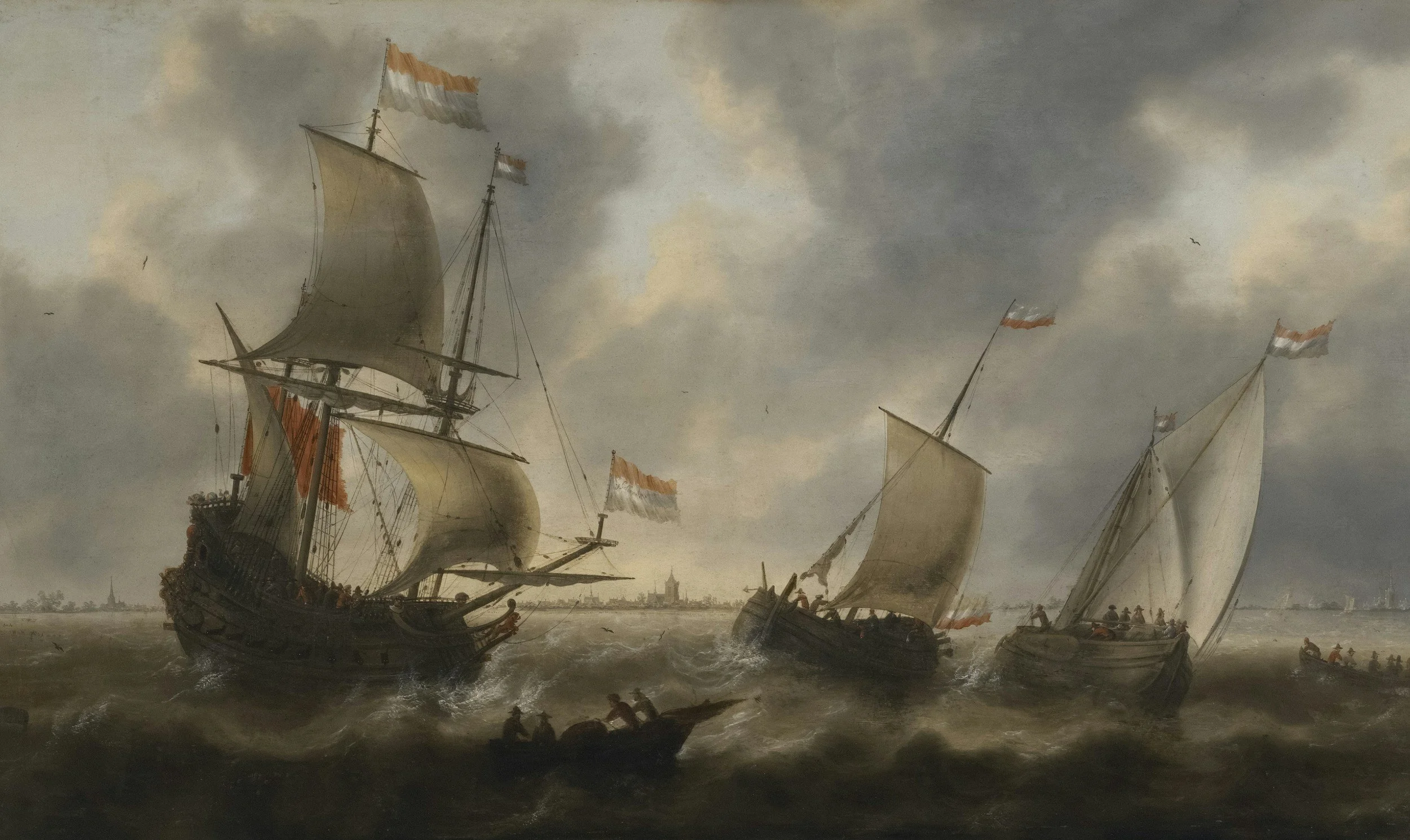
Oh no! Out of the mist, I can see the enemy, six British warships, their flags snapping in the wind. The British fleet is firing on our ship, which I think is called the Lawrence. Our ship is firing back, but the cannon shot hits the water and isn’t even close. It’s obvious the British have better cannons, and it appears that their crews are more experienced.
I can hear Perry’s men whispering nervously. Some of them are farmers, others are carpenters, and few look like they have ever seen battle.
Perry glances at his ships. The Lawrence leads the line, followed by eight other vessels. His officers are waiting for orders, but Perry doesn’t hesitate. He reaches into a small chest and pulls out the blue flag we saw in the study.
Perry: “Men, this flag bears the words of Captain James Lawrence, my friend, who died fighting for our country. Remember them well: Don’t Give Up the Ship! We have come here to fight, and that is what we shall do.”
The men cheer as the flag unfurls. It flaps wildly in the wind, catching the first rays of sunlight through the clouds.
Then, another low boom echoes across the lake. The British have fired a second shot.
Cannonballs whistle overhead. One crashes through the deck, showering splinters on us! Let’s stay low! More cannon fire is hitting the Lawerence. It looks like our ship is being targeted first.
Perry takes cover when needed, but stands in sight of all his men on the ship.
Perry: “Hold fire! Wait until we’re in range!”
The British guns have longer reach. Their cannonballs slam into the Lawrence again and again, tearing holes through the sails, snapping ropes, and scattering debris. Throughout all of our travels together, this is the most dangerous spot we’ve been in. We need to get out of here and back to the study, but I can’t reach the notebook in my bag!
I think the Lawrence is finally shooting back at the British fleet. Another cannonball smashes into the main mast of the Lawrence, and oh no! Its falling into the Lake! Perry is shouting orders and waving at another one of the ships with a flag, signaling them to come close. Even during everything happening right now, he is showing that he is a true leader and being brave for himself and his men. Right now, we’re scared and not sure what to do next, but let’s follow his example and be brave.
Perry is ordering his men to abandon ship! They are getting into small boats and heading to one of his other ships. The British are firing on the smaller boats now and not at us! I think we can use the fact that they are distracted to get back to the study.
I think I can reach the notebook.
Let’s flip to the pages that brought us here.
Here they are! Are you ready? Let’s get to safety!
We made it! Let’s sit down for a minute and think about what we just went through and what we just saw. The blue flag lies folded on the desk again, still faintly smelling of salt and smoke. As we sit here, I can see a note clipped to the flag we found earlier. The note is red, and it looks like its folded up. Let’s open it up and read it together.
Beware. This sketch in the notebook will take you directly into battle. Do not choose this moment in history lightly. Every great moment in history carries consequences. As true as that is in history, it is true here. In this sketch, you will experience the consequences personally. Proceed with caution.
Wow. I wish we had read this before we left, but now we know. Let’s go to a mirror and make sure that we aren’t hurt too badly. I can see that my shirt and pants are torn, and my arms have cuts and scrapes from the flying splinters. Be sure to check your clothes and confirm that you’re okay!
Remember our word of the day? That’s right, courage. Today, we saw what courage looks like, not the absence of fear, but the choice to act despite feeling the fear. Perry could have surrendered when his ship was shattered, when nearly every man around him was dying or wounded. Instead, he found a way to keep fighting. Let’s see what the notebook says about what we saw today:
On September 10, 1813, amid the thunderous roar of cannon fire on the choppy waters of Lake Erie, Commodore Oliver Hazard Perry boldly commanded a fleet of nine American vessels against a superior British squadron during the War of 1812. His flagship, the USS Lawrence, bore the brunt of the enemy's relentless broadsides, its masts splintered, decks awash in debris, and over 80 percent of its crew killed or wounded, yet Perry defiantly hoisted his battle flag emblazoned with the dying words of Captain James Lawrence: "Don't Give Up the Ship." Refusing to yield even as his ship became a floating wreck, Perry dramatically transferred his command by rowing through a hail of musket balls and grapeshot to the undamaged USS Niagara.
To learn more about what happened next, you must travel back to the moment and experience it firsthand.
We didn’t have a chance to see how the battle ended. Let’s exercise the same courage, and when we are together again, go back to see what happened next. Perry’s courage reminds us that true bravery isn’t about not feeling fear; it’s about doing something in spite of the fear, even when everything seems lost.
Thank you for joining me for this dangerous adventure in Sketches in History! Don't forget to subscribe to the 15-Minute History Podcast so you won't miss a single journey. And if there's a moment in history you'd love to explore with me, send your ideas to 15minutehistory@gmail.com.
Until next time, keep wondering, keep imagining, and remember… the past is just a page away.
Discussion Questions
What does courage mean to you?
Why do you think Oliver Hazard Perry refused to surrender, even when his ship was destroyed?
How did Perry’s courage affect the people who were fighting with him?
Can you think of a time when you showed courage, even when something felt scary or impossible?