Sketches in History | Surrounded
Hello, and welcome back to Sketches in History! I’m Lottie Archer, your guide. Every week, we sit together in my grandfather’s study and open my magical notebook to a sketch from history, letting it pull us into the past to experience a moment first-hand. Last time, we saw how WW2 was won not just on the battlefields, but on the homefront. We stood inside a factory more than a mile long where a brand-new bomber rolled out the door every sixty-three minutes, and then we watched a mother in a quiet kitchen save her bacon grease in an old coffee tin. We learned that both the big actions of making bombers and the small actions of collecting grease and planting Victory Gardens helped the Allies win the war. I can’t wait to see where we go today!
It’s a spring afternoon in the study, and surprisingly chilly outside. The fire is going, low and hot, and the windows are fogged at the corners. There’s a draft coming in from somewhere, just enough to make the curtain move every once in a while. Grandfather’s desk full of the usual things, but through the clutter, there’s something new.
Do you see it?
It’s a small metal can. Olive green, dented on one side, with the paint scratched off in a few places. The label says C‐RATION. There’s a little folding key soldered to the top, the kind you twist to open the lid. I pick it up. It is so cold. Cold like it just came out of a freezer, except colder than that, the kind of cold that makes your fingers hurt right away.
The metal is hard and unforgiving, and I have to set it back down before I drop it. Tucked under the can is a piece of paper, folded in quarters, soft along the creases like it’s been opened and closed many times. I unfold it carefully. It’s a short note, written in pencil in tight, careful handwriting:
“We’ve been looking for the enemy for some time now. We finally found him. We’re surrounded. That simplifies things.”
That’s all. No name. No date. No explanation of where the writer was when he wrote it, or why being surrounded by the enemy would simplify anything. I bet the notebook will help us solve this mystery.
But first, let’s learn our Word of the Day: discipline. Discipline is what you do when nobody is making you do it. It’s practicing the piano at the same time, on the same days, even when you don’t feel like it. It’s finishing your homework before you turn on the TV. It’s deciding to clean your room every Saturday morning without your parents telling you to do so. It’s doing the right thing even when everything around you is going wrong. Discipline is what teams have when they keep working together under pressure, and what soldiers have when they keep moving when every part of them wants to stop. You are not born with discipline. It is a learned trait. You build discipline by deciding to improve in something or get better at something you’re already good at and working at it over and over. Do you know what’s really great about learning discipline? If you learn it in one area of your life, it will naturally show up in other areas. You learn it once, and as long as you work at it, it continues to grow throughout your life.
Alright. Let’s see what the notebook has to show us.
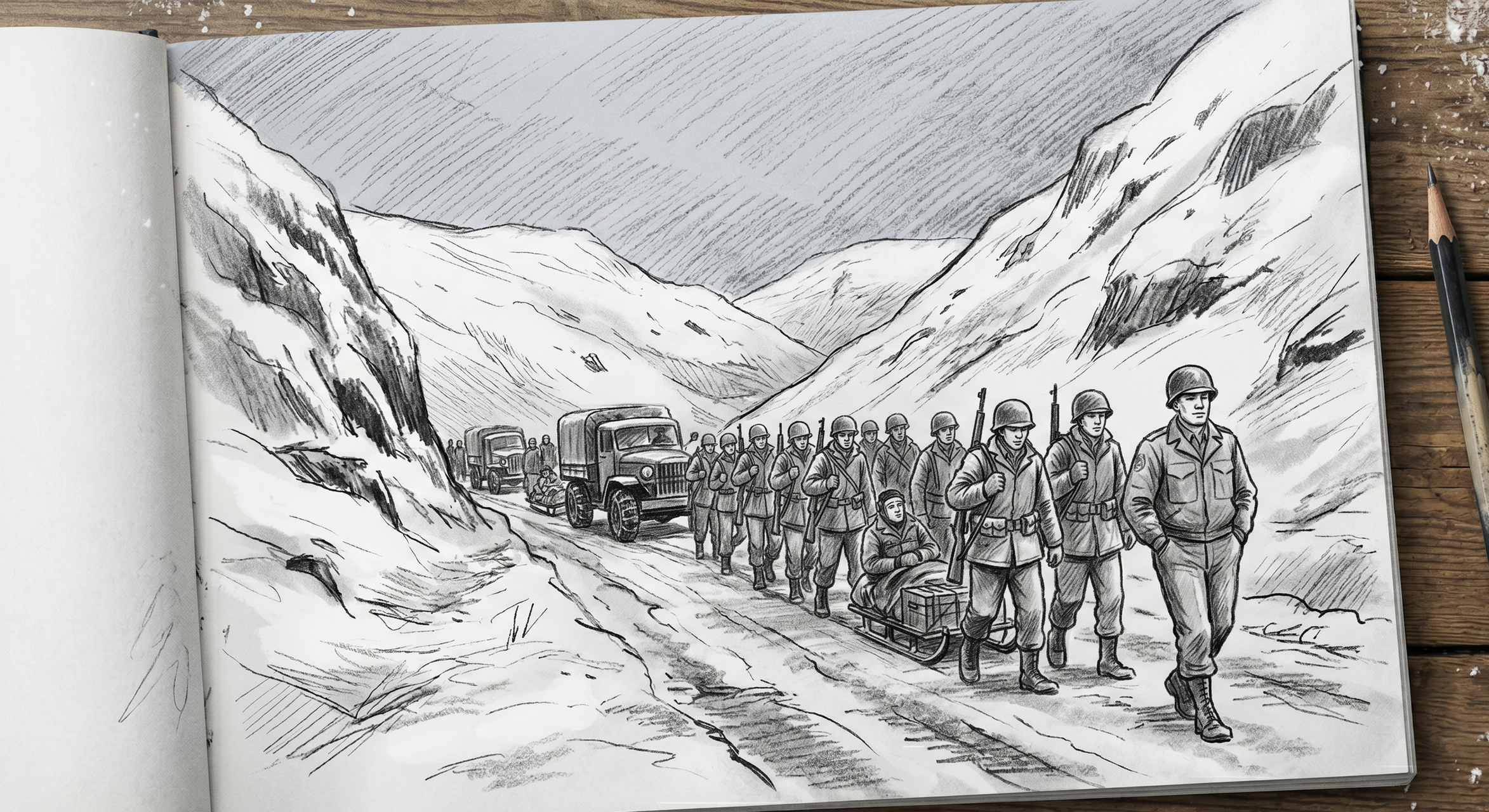
The sketch shows a long, narrow road cutting through a frozen mountain pass. Snow is everywhere. On either side of the road, dark hills rise up like walls, and the sky above is a hard, pale gray. A column of soldiers is moving down the road in single file, bundled in heavy coats, rifles slung over their shoulders. Some are pulling sleds with wounded men on them. A few trucks are mixed in, their tires wrapped in chains. At the front of the column, a stocky officer is walking with a calm, measured stride, like he’s simply on a relaxing walk.
The snow in the sketch begins to drift onto the desk. The cold seeps off the page. I can hear the crunch of boots.
Are you ready? Close your eyes, hold on tight, and let’s go!
We made it!
Oh my goodness, it is so cold. The kind of cold that hits you in the chest and makes it hard to breath. We have literally been here 10 seconds and my fingers are going numb. Think of the coldest you’ve ever been. Maybe it was while you were sledding or playing in the snow, or when you were walking to your car in January. Now, imagine that cold being so bad your hands freeze and your breath turns to ice as it leaves your mouth!
I’m looking around, and the world is white and gray and blue, and the wind is so loud I can barely hear the soldiers speaking to one another. Based on what I can make out, we’re standing on the side of a road in the mountains of North Korea. The year is 1950, just a few days after Thanksgiving. This place is called the Chosin Reservoir, and there’s a battle happening here.
The thermometer, if there were one, would read thirty degrees below zero. Listen, you can hear the soldiers talking about it. The oil in their rifles has frozen into sludge. Their fingers are so stiff that pulling a trigger takes everything they’ve got. When they breathe, the air crystallizes right in front of their faces. When they try to eat, their food has turned to ice inside the tin. When they try to sleep in shallow holes they’ve hacked out of frozen ground, they have to wrap themselves in every layer of cloth they can find.
And they are surrounded.
A few nights ago, on November 27, more than a hundred thousand Chinese soldiers came down out of these hills in a surprise attack. Entire American units were cut off in the first hour. The road south, the only way home, came under steady artillery fire. The men of the 10th Corps had two choices. Stay and be destroyed, or fight their way out, mile by mile, in temperatures that could kill them just as easily as the enemy could.
There’s the officer from the sketch. His name is Colonel Lewis Puller, but everyone calls him Chesty. He’s short and barrel‐chested and walking up the line with his hands in his coat pockets like the cold is a small inconvenience. A young Marine, maybe nineteen years old, looks up at him from a foxhole.
Marine: “Sir, what do we do? They’re on every side of us.”
Chesty Puller doesn’t even slow down.
Chesty Puller: “Son, we’ve been looking for the enemy for some time now. We finally found him. We’re surrounded. That simplifies things.”
Did you hear that? It’s the same line from the note on grandfather’s desk. He really said it. And listen to the men around him laugh, just a little. They’re exhausted, they’re freezing, they’re outnumbered, and their commander has just told them that being surrounded makes the job easier, because now they can fire in any direction and hit the enemy. That’s Chesty exercising personal discipline. He’s not a panicking. He’s accepted the situation and working through what needs to be done as a result. His men see his personal discipline and exercise their own. Chesty is a leader who knows what his men need most, right now, is not a speech. It’s the steady example of someone who is not going to panic.
The column begins to move. Watch how they’re organized. There’s a rear guard at the back, fighting off attacks so the main body can keep moving. There are engineers near the middle, ready to repair bridges and clear roadblocks under fire. There are medics doing what they can for the wounded, trying to treat frostbite before it turns into something worse. Everyone has a job. Everyone is doing it.
A sergeant is walking past us, his face raw and red from the wind, urging two younger Marines forward.
Mile by mile, they continue to move. Can you hear what the Marines are saying? For sixteen days, the men of the 10th Corps have fought their way down that mountain road. They never broke. They never scattered. When they finally reach the coast, most of them are still together, still in their units, still carrying their wounded. They didn’t win the battle, exactly. The Chinese held the field. But they didn’t lose either. They came out of the mountains as an army, not a mob, and that is something almost no force in history has ever managed under conditions this bad.
Let’s flip to the pages that brought us here and get back to the study.
We made it back!
My fingers feel so cold. Let’s go warm ourselves by the fire for a moment. I don’t know about you, but hearing Chesty’s words and seeing he and his men exercise discipline while be surrounded and freezing in -30-degree weather was inspiring. I want to learn that kind of discipline, don’t you?
The C‐ration tin is back on the desk where we left it. But there’s something new now, something the notebook left behind for us to see. Let’s walk over to the desk to get a better look.
It’s a folded newspaper, a few pages thick, the headline running across the top in big black letters: TRUMAN FIRES MACARTHUR. The date is April 11, 1951, just a few months after the Marines came out of those frozen mountains.
Here’s what happened. The general in charge of the war, Douglas MacArthur, was a famous and very confident man. He believed he could win the war by attacking China itself, even with nuclear weapons if he had to. President Harry Truman didn’t agree. He thought attacking China would start a third world war, and he ordered MacArthur to stay south of certain limits. MacArthur disobeyed. He criticized the President in the newspapers. He sent forces where he was not supposed to send them.
And so President Truman did something that took just as much discipline as anything that happened on that frozen road. He fired one of the most famous generals in American history, in the middle of a war, because in our country, the people elect a President and a Congress, and those parties, not the general, decide when and where America goes to war.
Remember our word of the day? That’s right: discipline. Today we saw what discipline really looks like. It’s a Marine putting one foot in front of the other in air so cold his rifle won’t work. It’s a colonel making a joke about being surrounded so his men don’t lose heart. It’s engineers and medics and sergeants each doing their small part of a very large job, in the worst conditions you can imagine, because they trust each other to do theirs. And it’s a president, sitting in a warm office thousands of miles away, choosing to follow a rule even when it costs him a famous general. Discipline isn’t just doing hard things. It’s doing the right things, in the right order, when the easy thing would be to give up or give in.
Now let’s look at what the notebook says about what we just saw:
The Korean War began on June 25, 1950, when North Korean forces, backed by the Soviet Union, crossed the 38th parallel and invaded South Korea. The war was the first major armed conflict of the Cold War and the first military action authorized by the United Nations, with troops from nineteen nations fighting under the UN command. The Battle of Chosin Reservoir, fought from November 27 to December 13, 1950, took place in temperatures as low as thirty degrees below zero. American and allied forces, including Colonel Lewis “Chesty” Puller and the 1st Marine Regiment, were surrounded by more than a hundred thousand Chinese troops, and fought their way south over sixteen days in what became one of the most studied fighting withdrawals in military history. In April 1951, President Harry Truman removed General Douglas MacArthur from command after MacArthur publicly disagreed with him about the conduct of the war. The decision reaffirmed the principle that elected civilian leaders, not military commanders, hold final authority over the use of force. The Korean War ended in an armistice signed at Panmunjom on July 27, 1953. No formal peace treaty was ever signed, and the demilitarized zone established between North and South Korea remains in place today.
Wow, what a journey! We held a tin so cold it hurt to touch, we walked a mountain road with the toughest Marines who ever lived, we heard Chesty Puller make a joke that turned a disaster into a plan, and we watched a president protect a rule that has held our country together since the very beginning.
Thank you for joining me on Sketches in History! Don’t forget to subscribe to the 15-Minute History Podcast so you won’t miss a single journey. And if there’s a moment in history you’d love to explore with me, send your ideas to 15minutehistory@gmail.com.
Until next time, keep wondering, keep imagining, and remember… the past is just a page away.
Discussion Questions
Chesty Puller told his men that being surrounded made things simpler. Why do you think a joke like that helped, instead of making things worse? What’s a time someone said something that made a hard moment feel easier?
The Marines at Chosin Reservoir were freezing, exhausted, and outnumbered, but they stayed in their units and kept moving. What do you think made that possible? Do you think you could do something hard if everyone around you was doing it too?
President Truman fired a famous general for not following orders. Was that a brave decision or a risky one, or both? Why does it matter who gets to decide when a country goes to war?
Discipline doesn’t only happen in big moments like a battle. Where in your own life do you have to use discipline? What would change for you if you got better at it?
The Korean War ended with an armistice, not a real peace treaty, and North and South Korea are still divided today. Do you think a war can really be “over” if the disagreement that started it is never settled?