“Daring Mighty Things” | The Panama Canal
An immense battleship passed silently through the water with two escorting cruisers. In the distance, rainclouds shrouded the coast. A sailor on deck busied himself with his duties and occasionally felt a surge of pride. Aboard were two dignitaries on a historic journey, and his shipmates were charged with their comfort and care. As he walked purposefully down the starboard side, a door opened and the captain appeared. The sailor stopped and saluted. Then a stout, broad-shouldered man in a white suit appeared behind the captain, and the sailor doffed his cap and gave another salute. The President of the United States nodded and returned the salute, his smile turning the corners of his bushy mustache upward. When the First Lady emerged from the cabin, the president took his wife’s hand, and together they began their morning stroll around the USS Louisiana, the largest warship ever built by American hands. Bright blue eyes behind wire-rimmed spectacles turned toward the shore, now barely visible as the rain moved inland. As he walked, the president thought about his destination and, more important, his purpose. For centuries, the land upon which he gazed had been an impassable barrier. Now, America would break through it. Rocks and trees were no match for American will and might. He would see to that. Another smile as he thought to himself, “Bully.”
The “Free and Independent Condition”
Eight years after the United States had won the Battle of New Orleans and survived the War of 1812, President James Monroe spoke to Congress about a new chapter in American foreign policy. In his message, what today we would call a State of the Union address, the president declared that “the American continents, by the free and independent condition which they have assumed and maintain, are henceforth not to be considered as subjects for future colonization by any European powers.” What became known as the Monroe Doctrine was, in effect, America drawing a line down the map and declaring the Western Hemisphere to be out of bounds for European interference. Spain, Portugal, and other imperial states could not interfere or send troops to hold onto their Latin American colonies, which gradually won their independence during the 19th century.
America’s purpose in the Monroe Doctrine was twofold. First, it had spent decades being pulled into European affairs during the tumultuous French Revolution and Napoleonic Wars, and it was tired being a pawn in the great imperial game. Second, it hoped to build and maintain trade relations with the newly-independent Latin American states, which would lessen its need for European money and goods. Here the United States found an unlikely partner: Great Britain. Exhausted by twenty-plus years of war with France, the British hoped their trade with independent former colonies would let them recover and rebuild their economy. When the authoritarian continental powers of Europe scoffed at the Monroe Doctrine, effectively asking America “you and what navy,” Britain replied by offering the thousand warships of the Royal Navy to enforce this new geopolitical reality.
The limits of technology and America’s turn inward to focus on domestic affairs left the Monroe Doctrine more as a theoretical model than a practical reality. The country mostly limited its foreign policy to supporting anti-European rebels like Simón Bolivar and battling pirates in the Caribbean. As the United States grew in industrial and naval strength, it gradually supplanted the British Royal Navy as protector of Latin American trade and independence. Rising North-South tensions and the Civil War allowed Spain and France to establish a presence in the Dominican Republic and Mexico, respectively, but these colonies collapsed soon after the Union’s victory in 1865 as America once again regained mastery of the Caribbean Sea.
Gunboats, Big Sticks, and Bananas
As a fresh wave of European imperialism swept across Africa, Southeast Asia, and the Pacific basin in the 1880s, American progressives began to look on Latin American states much like parents might view their children. These nations needed strong guidance from the regional superpower, who would teach their peoples about democracy and market economics—for a price. Nearly every president from Abraham Lincoln to William McKinley (with the exception of the strict constitutionalist Grover Cleveland) used either soft or hard power to block foreign missions and promote American interests in Latin America. The United States’ use of “gunboat diplomacy,” sending armed missions to coerce Latin American governments into opening their markets both enhanced American power in the Western Hemisphere and bred seething resentment in many local populations.
A turning point in U.S.-Latin American affairs came in 1898 with the outbreak of the Spanish-American War. Officially, it was a defensive conflict; America blamed the Spanish government in Cuba for the destruction of the USS Maine in Havana harbor in February 1898. But American progressives also saw an imperial vision for their country, one in which the United States would replace Spanish oppression of the Cuban people with a democratic, free-market, and pro-American regime. The war was a brief and stunning success. America hurled the Spanish out of Cuba and won control of Puerto Rico in the peace (as well as new Pacific territory in the Philippines and Guam). President William McKinley had won America an overseas empire, but an assassin’s bullet denied him the chance to govern it.
On assuming the presidency in 1901, Theodore Roosevelt came to office with a clear vision for America’s role in the world. While still vice president, he had expressed his ideas in a speech quoting an African proverb: “Speak softly and carry a big stick.” Roosevelt believed the United States ought to act as an honest broker in the world and use peaceful negotiations to settle international conflicts whenever possible, but it should also be ready and willing to use force to protect its interests abroad. His administration spoke softly when the president mediated an end to the Russo-Japanese War in the Treaty of Portsmouth in 1905 (winning him the Nobel Peace Prize) and settling a crisis in Morocco between France and Germany at the Algeciras Conference in 1906. Outside the Western Hemisphere, Roosevelt showed the world America’s “big stick” with a naval building program that produced the U.S. Navy’s “Great White Fleet,” sixteen top-of-the-line whitewashed battleships that toured the world and showed foreigners that America was not a power to be ignored or discounted.
Closer to home, Roosevelt focused his gaze on Central America. In the 1880s, France had tried to build a canal linking the Atlantic and Pacific oceans through Nicaragua, but the enterprise met one disaster after another before its collapse in 1889. Roosevelt believed that America could do better further south in Panama, then part of the Republic of Colombia. To build a canal, the president first had to secure American ownership of Panamanian land, which would be a complicated process. The nearby nation of Venezuela had defaulted on foreign loans, and both British and German warships were blockading its coast to force payment to their governments. Roosevelt began his Panama project by driving away these foreign vessels, which ensured both Venezuelan gratitude and friendship toward the United States and no foreign interference in a future canal zone to the northwest. Next, the State Department began sending American money to fund an insurrection in Panama Province against the Colombian government. Panama won its independence in 1903, but America’s role in the conflict led to intense Colombian resentment—which still persists today. Finally, President Roosevelt established an American protectorate regime in Panama that agreed to a treaty giving the United States ownership of a canal zone stretching from coast to coast. America could now fulfill Roosevelt’s dream (which we will come to shortly).
Political opposition to Roosevelt’s actions led him to make a public change to the Monroe Doctrine in 1904, shortly after Panama won its independence. In that year’s message to Congress, the president articulated what became known as the “Roosevelt Corollary:”
If a nation shows that it knows how to act with reasonable efficiency and decency in social and political matters, if it keeps order and pays its obligations, it need fear no interference from the United States. Chronic wrongdoing, or an impotence which results in a general loosening of the ties of civilized society, may in America, as elsewhere, ultimately require intervention by some civilized nation, and in the Western Hemisphere the adherence of the United States to the Monroe Doctrine may force the United States, however reluctantly, in flagrant cases of such wrongdoing or impotence, to the exercise of an international police power.
The Roosevelt Corollary laid the groundwork for what became known as the “banana wars.” American food companies established strong ties with farmers across Central America. Whenever local conditions disrupted American access to crops—especially coffee and bananas—these companies petitioned the State Department to intervene and protect their vital interests. From 1904 until the Great Depression, the U.S. Marine Corps was on near-constant duty toppling hostile regimes, battling local militias, and protecting plantation farms from hostile government troops across the length and breadth of Central America. Nicaragua and Honduras felt the “blessing” of American democracy regularly as the United Fruit Company built up a banana monopoly, protected it with the largest military force in the Western Hemisphere, and toppling the democratically-elected governments of Honduras (four times) and Nicaragua (eleven times). Even as American soldiers fought the Germans in the trenches of the First World War, their Marine comrades were protecting the sanctity of the American banana split and morning coffee. Other Caribbean and Central American nations were targets of gunboat diplomacy and hosted banana wars, and the resulting economic dislocation and political stability left a bad taste in the region still felt a century later.
“While the Debate Goes on, the Canal does also”
Building a canal across the Panamanian isthmus would benefit the United States and the world—at least in Theodore Roosevelt’s mind. It would shorten the distance traveled by ships around the globe and let them avoid the treacherous waters off Tierra del Fuego at the lower tip of South America. The United States, as owner of the canal, would make millions charging foreign ships for passage, and American consumers would pay less for products with lower transport costs. Finally, the U.S. Navy could move ships more quickly from east to west to respond to growing threats from aggressive powers like Germany and Japan. Building the canal was a no-brainer; the real question was how to do it.
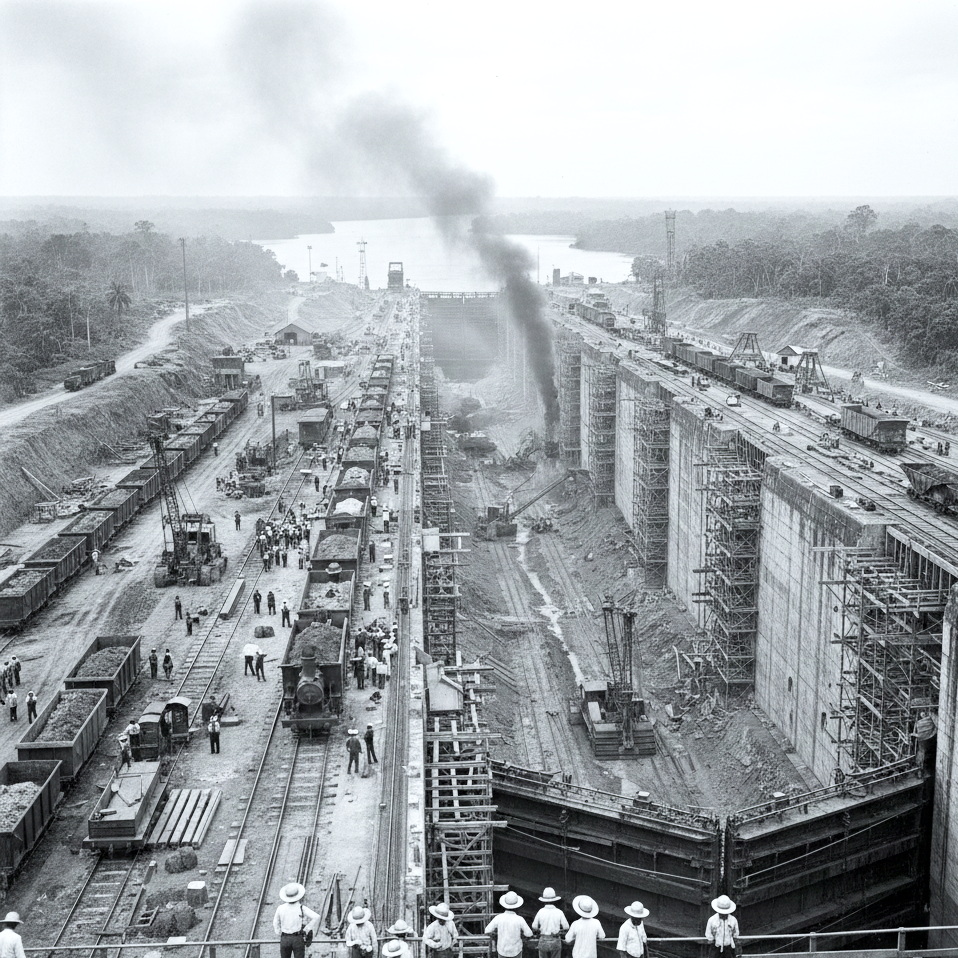
Panama has some of the harshest terrain on earth for blasting a path through a continent. Mountains rise quickly off the coastal plain, and the jungle climate brings with it the threat of deadly diseases. American engineers and doctors surveyed the canal zone once the Panamanian treaty was signed and planned where to build locks to raise and lower ships across the terrain and how to keep workers safe and healthy during construction. Colonel William Gorgas and Major Walter Reed developed medical safety protocols to protect American and Panamanian workers from malaria and yellow fever, earning them worldwide praise for their success. Army engineers like John Frank Stevens and George Goethals planned the intricate network of artificial waterways leading from the oceans to the manmade Gatun and Miraflores lakes. And a total of 75,000 workers moved nearly 300 million cubic yard of earth with 27,000 tons of dynamite to complete one of the largest and most impressive works of human engineering in history. Back home, Theodore Roosevelt and his successors, William Howard Taft and Woodrow Wilson, fought political battles over funding and press reports—real and exaggerated—about working conditions. But the work never stopped. Roosevelt even became the first sitting president to travel abroad when he sailed aboard the USS Louisiana to visit the site, greet local dignitaries, and thank the builders for their work in 1906. Day by day, yard by yard, Roosevelt’s dream of a canal drew closer to reality. Unfortunately for the now-former president, not to mention those who had done the work, news of the Panama Canal’s opening in mid-August 1914 did not make the front page of the world’s newspapers; they were too busy covering the German onslaught into France in the opening weeks of the Great War.
A Mixed Legacy
Joe and I planned this topic and broadcast date back in the early fall of 2024, and recent events that have revived conversations about the Monroe Doctrine and America’s history in Latin America make this episode very relevant. The United States seems to be withdrawing its strength from the Eastern Hemisphere and refocusing on the Western. The current administration is building close ties with ideological partners like El Salvador, backing right-of-center candidates and parties in places like Honduras and Brazil, and planning and executing special operations missions in Venezuela—and perhaps elsewhere. As with all of history, the legacy of American foreign policy in Latin America is mixed, controversial, and subject to intense debate. Many question honestly whether or not the United States needed—and needs—to send its military into other countries to protect its foreign interests, and the shadow of past regime-change wars loom large over these conversations.
So let’s look at some facts, and I leave interpretation and application to you. Had the United States not protected Latin America from predatory imperial powers in Europe during the 19th century, those nations would have likely suffered fates similar to African colonies in the same period: resource exploitation, economic deprivation, and even local genocide. We cannot be certain, but history tells us that the imperial European powers had even less regard for local opinions and livelihoods than America did. Now, did the United States exploit some resources and deprive some nations of economic prosperity during the banana wars? Yes. And do the people of Latin America still feel those effects today? Yes. States like Nicaragua, Cuba, and Venezuela lost out on decades of political independence and economic stability that could have strengthened their societies against radicals and revolutionaries. But is America to blame for every problem in these troubled regions? No. Plenty of Latin American struggles are rooted in their own decisions—they elected authoritarian leaders or embraced collective economic models despite plenty of evidence that they provide neither security nor prosperity. Daniel Ortega, Fidel Castro, and Hugo Chavez could blame the United States for conditions on the ground, but their own people must bear some responsibility for the harms they caused and the crimes they committed. It sounds harsh, but facts are stubborn things. Yes, America destabilized their societies—which is regrettable—but individuals must bear some responsibility for solving problems.
One final question. Do America’s adversaries today work to access and control the vast natural wealth and strategic locations in Latin America? Yes. A meme spread online after the fall of Nicolás Maduro made this clear, asking whether China and Russia were in Venezuela for its oil reserves or the recipe for arepas. The United States, like every nation on earth, has a responsibility to protect its people from foreign threats. But does that mean America should implement what people are already calling the “Don-roe Doctrine” with a more aggressive foreign policy to our south? I don’t have an answer to that one. I can only pray that our leaders, our pundits, and you in our audience filter out the political noise, look at the facts on the ground, and let history be a guide.