Sketches in History | Panama Canal
Hello, and welcome back to Sketches in History! I'm Lottie Archer, your guide. Every week, we sit together in my grandfather's study and open my magical notebook to a sketch from history, letting it pull us into the past to experience a moment first-hand. Last time, we witnessed incredible courage on Lake Erie during the War of 1812. I can't wait to see where we go today!
Out the window, snow is falling. I can see it caught in the wind and blowing out into the darkness, out of sight. Glad we’re in here with a roaring fire and warm blankets. As I stay warm by the fire, I see a small bottle on the mantelpiece. Do you see it? Let’s go over and check it out. This is interesting, it’s a small glass vial filled with what looks like dirt, sealed with a cork, and tied with a faded yellow ribbon. A label reads "Culebra Cut, 1907." The dirt inside is reddish-brown, almost like rust, and when I hold it up to the lamplight, I can see tiny flecks of something sparkling within it.
I wonder what makes this little bit of earth so special that someone would save it in a bottle? I bet there’s an incredible story here!
But first, let's learn our Word of the Day: Resilience. Have you ever built a sandcastle and watched the waves knock it down, but then you built it again, maybe in a different spot or a different way? That's resilience! Resilience means bouncing back when things go wrong. It's not just about trying again; it's about adapting and getting stronger each time something knocks you down. Like most virtues, it takes time to learn and to build. You build it by doing difficult things where you have to keep trying until you get it right. Building resilience helps us survive tough times and come back even better.
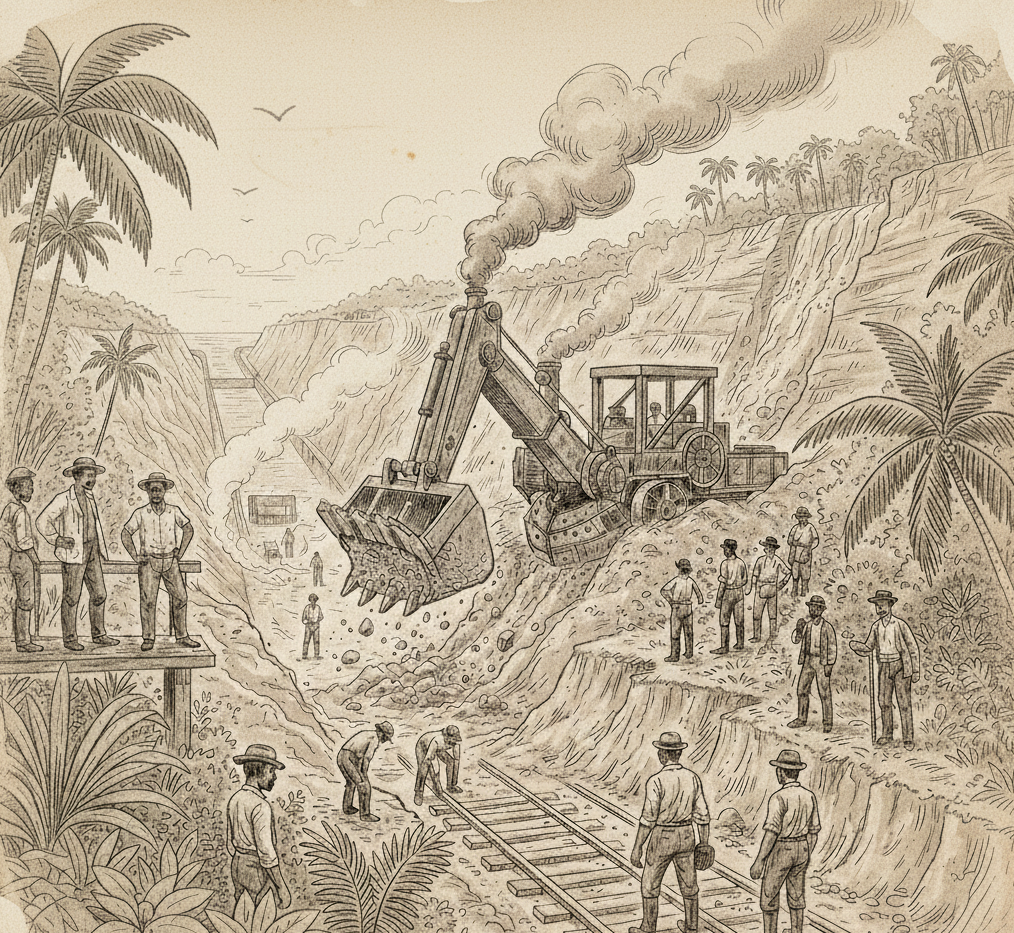
Alright, let's see what the notebook has to show us. The sketch this time shows a massive cut through a mountain, with tiny figures of workers scattered across the slopes. Steam shovels bite into the earth, and train cars loaded with dirt wind along tracks at the bottom. In the distance, I can see two oceans, separated by this narrow strip of land. The dirt in the drawing is starting to shift and crumble. The steam from the machines begins to rise.
Are you ready? Close your eyes, hold on tight, and let's go!
We made it! Oh wow, it's so hot and humid here! The air is thick like a wet blanket, and I can hear strange bird calls from the jungle all around us. The ground beneath our feet is muddy and slippery. We're standing on a wooden platform overlooking an enormous ditch, no, it's more like a canyon that people are digging!
Let's find somewhere safe to watch. Over there, behind those supply crates!
I can see thousands of workers below us. They're from all over the world. I hear English, Spanish, and languages I don't recognize. Giant steam shovels, bigger than houses, are scooping up dirt and rock. Dynamite explosions echo in the distance, making the ground shake beneath our feet.
A man in a white suit and Panama hat is standing on another platform nearby, studying maps with several engineers. Wait, I think that's John Stevens, the chief engineer! If I'm right, this is 1907, and we're witnessing the construction of the Panama Canal, one of the greatest engineering challenges ever accomplished!
Let me look around while they're talking. Down below us, there are at least twenty steam shovels working at once. Each bucket holds five cubic yards, that's like picking up a small room's worth of dirt in one scoop! The noise is absolutely deafening. Dynamite just went off again; they must be blasting every few minutes to break up the rock.
Over there, past the supply depot, I can see rows and rows of houses. They look so American, with white picket fences and everything! There's even a baseball field where some off-duty workers are playing. It's strange seeing such a normal-looking town right next to this massive industrial operation.
Stevens is pointing at the mountains ahead, speaking to his team.
"Gentlemen, the French tried for twenty years and failed. They said cutting through the Continental Divide was impossible. They lost 20,000 workers to disease and accidents. We don't believe in impossible!"
"Sir, the landslides in the Culebra Cut buried three steam shovels just yesterday. The men are starting to say the mountain doesn't want to be moved."
Stevens picks up a handful of that reddish dirt, the same color as what's in the vial back in the study.
"This mountain has stood here for millions of years. But inch by inch, pound by pound, we're going to move it. Not because it's easy, but because connecting these two oceans will change the world forever."
Suddenly, a whistle blows. Everyone stops working and looks up the hill. Oh no! The side of the mountain is moving! It's a landslide! Workers are running, shouting warnings in different languages. The massive wall of mud and rock is sliding down toward the canal floor. Steam shovels are being pushed aside like toys. Months of work are being undone in seconds!
But watch, even as the dust settles, even as they survey the damage, the workers aren't leaving. They're already planning how to clear it and start again. One worker, his clothes covered in mud, actually starts singing, and others join in. They're not giving up!
Oh my goodness, look over there! There's a whole train of dirt cars snaking through the bottom of the cut. The notebook says trains run through here every thirty seconds, and they weren't exaggerating! As soon as one train leaves loaded with dirt, another empty one arrives. The organization is incredible; it's like watching a giant clockwork machine.
I can hear so many different languages! That group of workers over there is speaking Spanish, and I think those men are speaking Italian. The notebook mentioned workers from 97 different countries! There's a crew that looks like they're from the West Indies, singing work songs to keep rhythm as they lay track. Even though they can't all understand each other's words, they seem to understand the work.
Wait, what's that smell? It's... oil? There are men walking along the edges of puddles, pouring oil on the water. One of them is wearing a badge that says "Sanitary Brigade." They must be Dr. Gorgas's mosquito hunters! Every pool of standing water gets the oil treatment to kill mosquito larvae. No wonder there are screens on every single building I can see. These brigades helped eradicate Yellow Fever and Malaria, both of which have killed thousands of workers here during construction.
I'm noticing more details about this incredible place. There's a commissary across from us with a sign advertising "American goods at fair prices." Workers are lined up to buy familiar food from home. A poster on the wall says there's a dance at the YMCA on Saturday night.
Look at that machinery graveyard over there, that must be old French equipment! Rusted steam shovels and locomotives are scattered like giant metal skeletons.
The heat is making everyone pour sweat. I can see why disease spread so quickly before Dr. Gorgas fixed things. A worker just told me that in the old French hospital, they put the legs of beds in bowls of water to stop ants, but that just gave mosquitoes perfect breeding spots!
I think our time here is almost up. As we prepare to leave, I can see Stevens and his team already directing the cleanup. Steam shovels are moving back into position. Workers are laying new track for the dirt trains. They're not just continuing, they're improving their methods, learning from each setback.
Let's flip to the pages that brought us here.
Here they are! Are you ready? Let's get back to the study!
We made it! The little vial of dirt sits on the desk, but now it seems so much more precious. This isn't just dirt , it's earth that was moved by people who refused to give up on an impossible dream.
Look, there's a telegram tucked under the vial. Let's read it:
“August 15, 1914. THE PANAMA CANAL IS OPEN. First ship passed through today. The impossible has become possible. Fifty miles of canal now connect the world's two greatest oceans. To all who said it couldn't be done , it is done."
Remember our word of the day? That's right, resilience. Today, we witnessed what resilience looks like on a massive scale. The Panama Canal took the United States ten years to complete. Workers faced tropical diseases, dangerous working conditions, and constant setbacks. The Culebra Cut alone required moving over 100 million cubic yards of earth. But they didn't just keep going; they adapted, learned, and came back stronger after each setback, until they achieved what the world said was impossible.
Let’s see what the notebook says about what we witnessed:
The construction of the Panama Canal stands as one of humanity’s greatest triumphs of perseverance over seemingly insurmountable obstacles. Between 1904 and 1914, under American direction, over 75,000 workers from around the world labored to carve a 50-mile waterway through the Continental Divide, battling not only the mountain’s frequent landslides but also tropical diseases that had defeated the French attempt decades earlier. The Culebra Cut, which was later renamed, proved the most challenging section, requiring the removal of over 100 million cubic yards of earth and rock that stubbornly slid back into the excavation with heartbreaking regularity. Yet through innovative engineering, improved living conditions for workers, and sheer determination to continue despite countless setbacks, the canal was completed, forever changing global commerce and proving that perseverance can indeed move mountains.
The Panama Canal reminds us that the biggest achievements often come from refusing to give up, even when everything seems to be against you. Those workers taught us that perseverance isn't just about working hard; it's about getting back up every time you fall, learning from your mistakes, and believing that tomorrow's effort might be the one that makes the difference.
Thank you for joining me on this muddy, challenging adventure in Sketches in History! Don't forget to subscribe to the 15-Minute History Podcast so you won't miss a single journey. And if there's a moment in history you'd love to explore with me, send your ideas to 15minutehistory@gmail.com.
Until next time, keep wondering, keep imagining, and remember… the past is just a page away.
Discussion Questions
What does resilience mean to you? Can you think of a time when you showed resilience?
Why do you think the workers were able to bounce back even after landslides destroyed their work?
How do you think the Panama Canal changed the world once it was finished?
If something you worked really hard on got destroyed, what would help you be resilient and try again?
The workers came from many different countries and spoke different languages. How do you think working together helped them be more resilient?