Sketches in History | One Bomber Every 63 Minutes
Hello, and welcome back to Sketches in History! I’m Lottie Archer, your guide. Every week, we sit together in my grandfather’s study and open my magical notebook to a sketch from history, letting it pull us into the past to experience a moment first-hand. Last time, we listened in as President Roosevelt sat down at a microphone and spoke to a frightened country like a neighbor. Today, we’re going to see what that same country did when it rolled up its sleeves and went to work.
It’s a quiet afternoon in the study. The sun is coming through the window in long, dusty stripes, and the room smells like old books and a little bit of pencil shavings. I walk past the shelves toward the desk, and something catches my eye. Do you see it? It’s a small piece of metal, no bigger than my hand, sitting in a little wooden tray. It’s shiny silver on top and a duller gray underneath, and there’s a row of tiny holes punched through it in a perfectly straight line. I pick it up. It’s heavier than it looks. The edges are smooth, like someone took the time to file them down so no one would cut their fingers.
Tucked under the tray is a folded paper tag, the kind you might tie to a Christmas present. The handwriting is careful and small. It says: “Willow Run. April 1944. One every sixty-three minutes.” That’s all. No name. No explanation. Just those three short lines. I have a feeling the notebook is going to show us what this is.
But first, let’s learn our Word of the Day: mobilize. To mobilize means to gather people and tools and energy together, all at the same time, and point them at one big job. When a soccer team gets ready before a game, the coach mobilizes the players. When your family gets ready to move to a new house, your parents mobilize boxes and tape and trucks. And as we’re about to see, an entire country once mobilized itself to do something so big that it had never been done before in all of human history.
Alright. Let’s see what the notebook has to show us.
The sketch fills the whole page. It shows a building so long that the artist had to draw it sideways to fit it in. There are rows and rows of windows. Smokestacks rise in the distance. Inside the building, I can see the shape of an airplane, and behind it another airplane, and behind that one another, all lined up like train cars on a track. Tiny figures of workers move between them. A woman near the front is holding what looks like a heavy tool, and her hair is tied up in a bright red scarf. The lights inside the factory begin to flicker and glow.
Are you ready? Close your eyes, hold on tight, and let’s go!
We made it!
Oh my goodness, listen to that! It’s loud. Really loud. The whole building hums, like the inside of a giant beehive, except instead of bees there are machines, thousands of them, all running at once. I can feel the floor humming under my shoes. The air smells like hot metal and oil and something like burnt toast. Let’s find a spot to hide and watch what the notebook wants to show us. Over here, behind this stack of crates.
We’re standing inside a place called Willow Run. It’s a factory, but calling it a factory is like calling the ocean a puddle. The building is more than a mile long. Yes, you heard me. One whole mile, from one end to the other. They built it out in the Michigan countryside, and it’s so big that the assembly line had to bend at a right angle just to fit on the property. Look up. The ceiling is so high it has its own weather. Dust drifts down through the lights like falling snow.
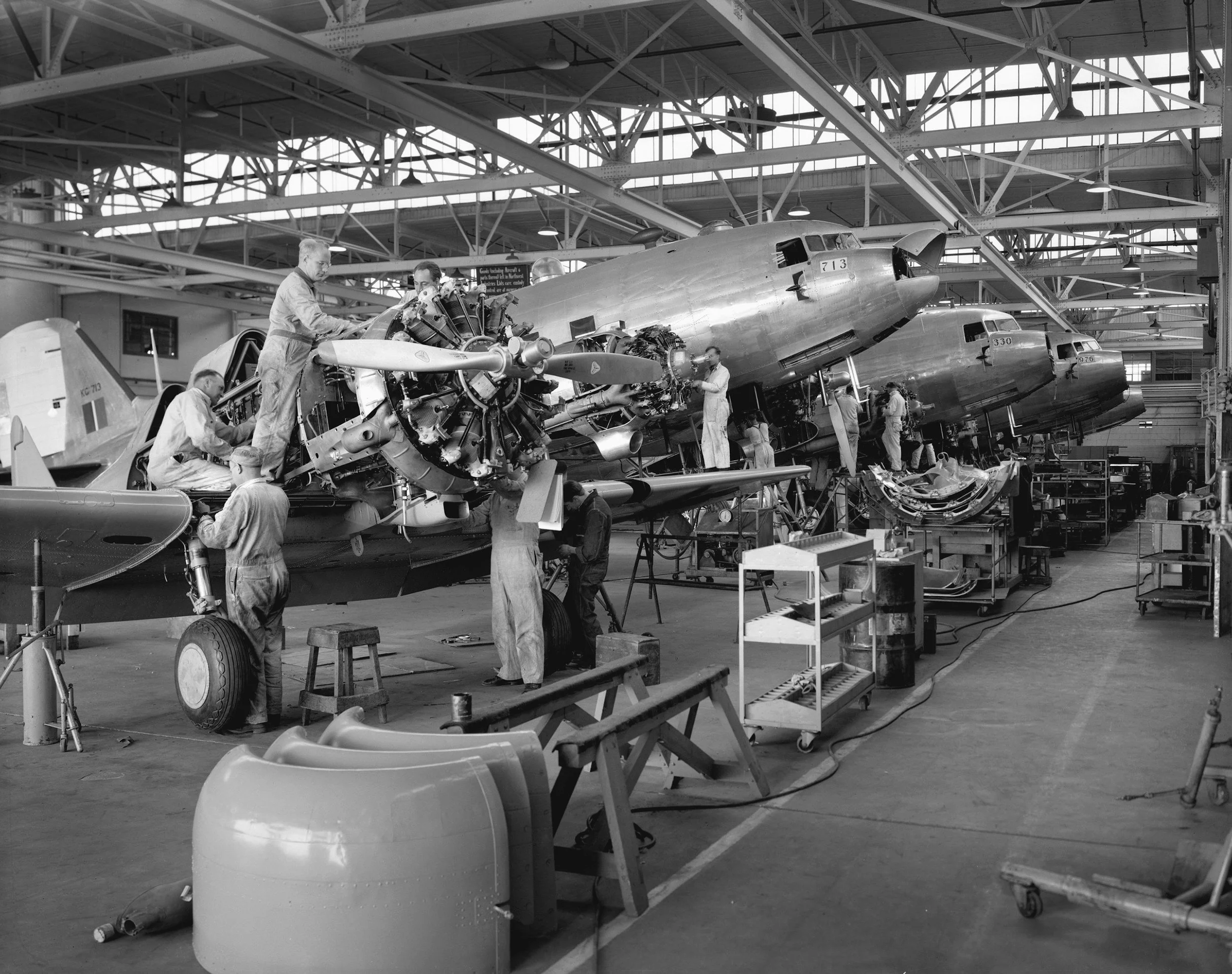
Now look down the line. Do you see those huge silver shapes? Those are bombers. Real ones. Each one is called a B-24, and each one is meant to fly across an ocean to help end the war. They start as just a frame at one end of the building. Then, as they move slowly along the line, workers add wings, and engines, and wires, and seats, and a million other little parts. By the time the airplane reaches the other end of the building, it can fly.
And here’s the part that’s hard to believe. A finished bomber rolls out the door of this building every sixty-three minutes. That’s about as long as a single class at school. Imagine if every time the bell rang, someone wheeled a brand-new airplane into the parking lot. That’s what is happening here, all day, every day.
Watch the workers. There are thousands of them, and a lot of them are women. That sounds normal to us, but in 1944, it was brand new. Most of these women had never worked in a factory before in their lives. A few years ago, they were teachers and store clerks and mothers at home. Then the men went off to fight in the war, and the country needed someone to build the airplanes. So the women came. They learned how to weld, how to rivet, how to read blueprints. Some of them turned out to be better at it than the men they replaced.
There’s one of them now, near the wing of that bomber. She’s wearing dark blue coveralls and a bright red bandana over her hair. She’s holding a tool called a rivet gun, which is a heavy machine that punches small metal pegs through two pieces of metal to lock them together, like a really powerful stapler. Watch how steady her hands are. She lines up the gun, pulls the trigger, and the whole wing rattles. Then she steps two paces to the left and does it again. She does this thousands of times a day. Her name might be Rose. There were a lot of Roses here, and one of them, Rose Will Monroe, became so famous for this kind of work that the whole country started calling women like her by the same nickname: Rosie the Riveter.
And listen. Underneath all the noise, can you hear that? It’s a radio. Someone has it tuned to a music station, and the workers near it are humming along while they work. They’re tired. A lot of them have been here since before the sun came up. But they keep going. Because every airplane that leaves this building means one of their husbands, or brothers, or sons might come home a little sooner.
A new sketch is forming, and this one is much smaller. A kitchen. A small wooden table with a checkered cloth. A little book on the table with stamps inside. A glass sugar bowl, mostly empty. A coffee tin that says “SAVED FAT” on a piece of masking tape stuck to the side. The drawing begins to glow. The kitchen window pulls us in. Let’s go!
We made it! Oh, this is different. Quiet. Warm. There’s a pot of something on the stove, and it smells good, like onions and a little bit of meat, but only a little. A radio is playing softly in the corner, and a woman in an apron is sitting at the table with a pencil and a small book. Let’s tuck in over here by the doorway and watch.
This is a kitchen in a regular American home. It could be in Indiana, or Texas, or Vermont. It’s 1943, the same year that bomber factory we just visited is humming away. And while the country is making airplanes by the hundreds, this kitchen is part of the same story, in a quieter way.
Look at the book on the table. That’s a ration book. Inside it are little stamps, like the kind you might collect at school for good behavior, except these stamps are the only way she’s allowed to buy certain things. Sugar. Coffee. Meat. Butter. Even the rubber on the soles of her shoes. The country needs all of those things for the soldiers and the factories, so everyone at home gets a fair share, and not a bit more.
She’s writing in a little notebook, adding up how many stamps she has left for the month. Coffee is the hardest one for her to give up. She used to drink three cups every morning. Now she stretches one cup as long as she can, and sometimes she just drinks hot water with a spoonful of chicory in it instead.
On the windowsill, look. Do you see that little tin can with dirt in it? She’s growing tomatoes. The whole backyard is full of vegetables now. She used to have flowers out there, but the government asked everyone to plant what they called a Victory Garden, so she pulled up the roses and put in beans and squash and carrots. Almost half of all the vegetables eaten in America right now are grown in little gardens like hers.
The radio is talking about the war. She listens for a moment, then turns it down. There’s a small framed picture above the sink. It’s her son. He’s in a uniform. She doesn’t know exactly where he is right now. Somewhere in Europe, probably. She writes him a letter every Sunday whether she has news to share or not.
Now watch what she does. She gets up, walks to the stove, and very carefully pours the leftover bacon grease from the morning into that coffee tin marked “SAVED FAT.” She’s saving it because the government is collecting it. The fat will be used to make something called glycerin, and glycerin will be used to make explosives. So the bacon she cooked for breakfast is going to help win the war, in a strange and roundabout way. Even her trash is part of the fight.
She sits back down at the table and picks up her pencil. She has work to do too. She’s an air-raid warden in her neighborhood, which means once a week she puts on a helmet and walks up and down her street making sure all the lights are turned off after dark, in case enemy airplanes ever fly overhead. They never do. But she walks anyway. Because that’s what you do.
She isn’t building bombers. She’ll never set foot inside Willow Run. But what she’s doing in this kitchen is part of the same enormous job. A whole country, mobilized, all at once, from the biggest factory in the world down to a little tin can of bacon grease on a kitchen counter.
Let’s flip to the pages that brought us here and get back to the study.
We made it back! The afternoon sun has shifted, and the study is even quieter than before. The little piece of metal sits in its tray exactly where we found it.
But now there’s something else on the desk that wasn’t there before. A photograph, in black and white. It shows a long line of workers walking out the front gate of a factory at the end of a shift. Men, women, all kinds of people. Some are tired. Some are laughing. One of them, a woman near the front, has pulled off her red bandana and is shaking out her hair. On the back of the photograph, someone has written a single line in pencil: “We did this together.”
Remember our word of the day? That’s right: mobilize. Today we saw what mobilizing really means, and we saw it twice. We saw it big, in a factory more than a mile long that turned out a finished bomber every sixty-three minutes. And we saw it small, in a kitchen where a mother saved her bacon grease in an old coffee tin so the country could make what it needed. The big and the small turned out to be the same thing. They were both part of the same enormous job. And the job got done not because one person was a hero, but because almost everyone decided, at the same time, that they would help. That’s a kind of strength that doesn’t fit in a history book very easily, but it changed the world.
Lets see what the notebook has to say about what it showed us today:
During the Second World War, the United States transformed itself in a way that had never happened before in human history. When Japan attacked Pearl Harbor in December 1941, the country was still climbing out of the Great Depression, with about one in ten Americans still out of work. Within four years, that number had fallen below two percent, and the United States was producing nearly half of the world’s manufactured goods. Federal spending rose nearly tenfold between 1940 and 1945, and the government spent more to win the Second World War than it had spent on everything combined from 1789 to 1940. The Ford Motor Company’s Willow Run plant in Michigan, more than a mile long, completed a B-24 Liberator bomber roughly every sixty-three minutes at peak production. About six million women joined the American workforce during the war years, many of them taking industrial jobs in shipyards, aircraft factories, and munitions plants that had been closed to women before. Rose Will Monroe, who worked at a bomber plant in Michigan, became one of the real-life inspirations for the cultural figure of Rosie the Riveter. At home, ordinary families participated through rationing, scrap drives, victory gardens, and civilian defense programs. By 1943, roughly forty percent of all vegetables consumed in the United States were grown in home and community gardens. Saved cooking fats were collected and processed into glycerin for munitions. About one in five Americans relocated during the war years, in one of the largest internal migrations in the country’s history. The home front was not separate from the war. It was the war’s engine. And the partnership between government, industry, and ordinary families that powered it would reshape the American economy, the workforce, and the country’s sense of itself for decades to come.
That’s really what the home front was. It wasn’t one big hero. It was millions and millions of regular people, in factories and kitchens and gardens and neighborhoods, all pulling in the same direction at the same time. By the end of the war, the United States was making almost half of everything in the world. Half. From a country that, just a few years earlier, hadn’t been able to find work for one out of every four of its people. That’s what mobilizing looks like when a whole nation does it together.
Thank you for joining me on Sketches in History! Don’t forget to subscribe to the 15-Minute History Podcast so you won’t miss a single journey. And if there’s a moment in history you’d love to explore with me, send your ideas to 15minutehistory@gmail.com.
Until next time, keep wondering, keep imagining, and remember… the past is just a page away.
Discussion Questions
At Willow Run, a finished bomber rolled off the assembly line every sixty-three minutes. Why do you think it was so important that they were built that fast?
Six million women went to work in factories during the war, doing jobs that had been closed to them before. What do you think happened in their families and their towns when so many women showed they could do that work?
The mother in the kitchen wasn’t building airplanes, but she saved her bacon grease, planted a garden, and walked her street as an air-raid warden. Was her work just as important as the work in the factory? Why or why not?
Mobilizing means pointing a lot of people and tools at one big job all at the same time. Can you think of a time your family, your school, or your team mobilized for something? What made it work?
By the end of the war, the United States was making almost half of everything in the world. What do you think changed inside the country, and inside the people who lived there, when they realized they could do something that big together?