The Arsenal of Democracy | Home Front USA
In 1932, the United States was a nation in crisis. Nearly one in four American workers was unemployed. Industrial production had collapsed, banks were failing, farms had been abandoned. The American Dream lay shattered in the barren, wind-swept Great Plains, and unemployed men and women tread its broken pieces into sidewalks across the country as they stood in lines waiting for relief or looking for a job. Even President Roosevelt's promise of a "new deal" for Americans took time, and as the years wore on, memories of economic insecurity shaped how they looked at work and evaluated risk.
And yet, little more than a decade later, the United States was producing nearly half of the world's manufactured goods. Its factories ran around the clock making everything from guns to butter. Workers earned steady wages and, in many cases, were on the job for more hours than ever before. The American economy had not just recovered—it was expanding beyond what anyone thought imaginable and emerged from the Second World War as the most powerful industrial force in human history.
Humanity's darkest hour transformed this world forever, reshaping how individuals thought about leadership, trade, and security. The sudden and overwhelming demands of global war required not only weapons and supplies but coordination, discipline, and a new understanding of how economies functioned. Though most nations on both sides of the war adapted as best they could, the United States was perhaps alone in just how vast this revolution shifted the fundamental institutions that undergirded its society. Change did not merely happen on the battlefield—it unfolded in shipyards and steel mills, redefined crowded cities and newly-built suburbs, was felt in ration lines and victory gardens, and turned the daily routines of ordinary Americans upside-down as they waged total war to man the arsenal of democracy.
This is the story of how the United States of America reinvented itself at home while its soldiers fought in the greatest war recorded on history's blood-stained pages.
Mobilizing
When the Japanese Empire attacked Pearl Harbor in December 1941, the Great Depression had loosened its vice-like grip on the American economy, but many of its effects held on stubbornly. Unemployment still hovered around ten percent, though far lower than its peak six years earlier. Likewise, industrial production had improved unevenly, and many Americans still depended on New Deal programs for basic necessities. In other words, the economy was recovering but was not yet secure. But in the weeks that followed America's entry into the war, everything began to change.
Federal spending surged on a scale the country had never seen. Starting in 1940, as America began hesitant preparations for a conflict, expenditures would rise nearly tenfold in just five years. The United States spent more than $300 billion to fight the Second World War—more than all federal outlays from 1789 to 1940. Let me say that again because it is almost beyond belief; America spent more to win the war against Hitler, Mussolini, and Tojo than it had to win control of a continent, build its industrial might, develop into a modern society, and win wars against foreign and domestic enemies. New agencies sprang up around Washington and opened offices nationwide to coordinate production, recruit and draft soldiers, and protect workers and the war effort from profiteers. They did more than regulate economic activity—they directed it. These government bureaucrats determined which industries would receive resources, which goods would be produced by large and small businesses, and how those products would be distributed. Military needs took priority over consumer production, and rationing controlled access to vital supplies of gasoline, rubber, meat, and sugar. Americans adjusted their daily living habits to support this national goal, sometimes grumbling but also proud of the role they were playing in the drive to victory.
In a fireside chat in May 1943, President Roosevelt spoke of the staggering results America's workers had achieved after seeing them firsthand on a nationwide tour. "We have moved into active and continuing battle with our enemies. We are pouring into the worldwide conflict everything we have—our young men and the vast resources of our nation...I saw thousands of workers on the production line, making airplanes, guns, and ammunition. The American people have accomplished a miracle." Perhaps the greatest miracle was the reduction in unemployment, which fell below two percent by 1943. In some sectors, labor shortages were becoming serious, and employers began recruiting workers from new demographics (which we'll discuss more in a moment). Wages were rising, savings were growing, and Americans were finding themselves in stronger financial positions than ever before.
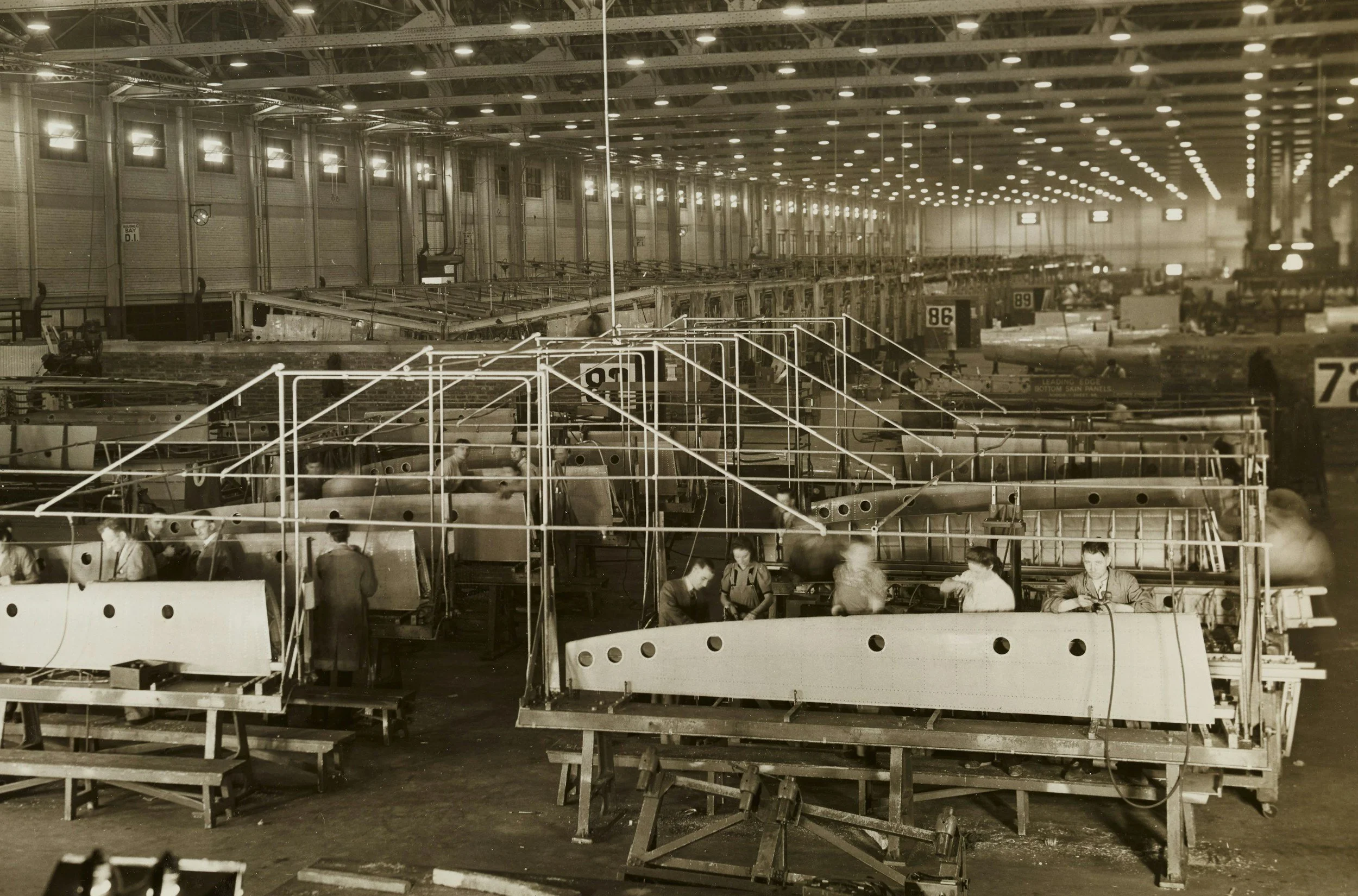
Detroit symbolized the disorienting speed and scale of this revolution more than any other American city. Once a heartbreaking picture of industrial collapse, it had become the beating heart of wartime production. Its population tripled in only a year as workers flocked to Michigan for high wages in the vast automotive factories now churning out tanks, aircraft engines, and military vehicles. At Willow Run, the Ford Motor Company's largest plant, the scale of production defied belief—a B-24 bomber rolled off the assembly line every 63 minutes as the company applied its mass production techniques to aircraft manufacturing.
This was not mere economic recovery—it was industrial mobilization on a scale the world had never seen. And for millions of Americans, it meant something profoundly important: not just the return of work but a return of predictability, routine, and a sense that work would again be rewarded. Letters and oral histories from this period are unanimous in the sense of relief and also momentum, that they and the country were moving forward again after years of uncertainty.
Transforming
Industrial expansion on this scale created new and immediate challenges. The labor force shrank as sixteen million men left the shops and assembly lines and could no longer sustain wartime production demands. The question was no longer whether the United States could make what it and the Allies needed; it was who would do the work, and under what conditions.
Between 1940 and 1945, about six million women entered the American workforce, bringing the total number of women in work to almost twenty million. Many moved into areas of the economy previously closed to them: shipyards, aircraft factories, and munitions plants that required not only physical labor but technical skill and precision. The Women's Army Corps developed training programs and taught complex tasks in a matter of weeks, as the urgency of production demands left little time for traditional apprenticeships. The cultural image of "Rosie the Riveter" captured this shift, and behind her smiling face and strong arms were real individuals navigating new and demanding roles. One of these was Rose Will Monroe, who worked at a bomber plant in Michigan and later became associated with the "Rosie" campaign. Like many women of her generation, she entered industrial work out of necessity but remained for its opportunities. Wartime employment offered wages far above what most women had previously earned, as well as degrees of independence and public participation that had been difficult to achieve in earlier years.
And yet this transformation existed within clearly-defined limits. Women were often paid less than men for comparable work, and employers often concentrated them in less skilled or less permanent positions. Government propaganda encouraged women to participate in the war effort but also emphasized that this was a temporary necessity rather than a permanent change—they were expected to leave the workforce once the war ended. Despite these mixed signals, American women played decisive roles by the millions in the Allied victory, and many military leaders paid tribute to their work; Douglas MacArthur called the Women's Army Corps "his best soldiers" for their discipline and the fact they complained less than the men under his command. Only time would tell how these women would react once they returned to domestic roles in society.
Another marginalized community entered the war effort at home (and on the battlefield). More than a million Black Americans relocated from the South to the North and West to work in wartime industries, and another million-plus enlisted for military service. This "second great migration" mirrored what had happened after the Civil War, and like that earlier period, came with both positive and negative results. Economic opportunity beckoned for families who had endured segregation in the South, but racism followed them into new parts of the country and led to lower pay and poor treatment on shop floors. Some industries refused to hire Black Americans. In 1941, the labor activist A. Philip Randolph threatened to organize a mass march on Washington to protest the exclusion of Black workers from defense jobs. President Roosevelt bowed to this pressure and issued Executive Order 8802, which prohibited racial discrimination in defense industries and established the Fair Employment Practices Committee. He did not, however, accede to demands that the military desegregate its fighting services, which remained racially divided until 1948. Growing wealth and higher job participation rates in the Black community allowed hundreds of thousands of families to free themselves from the economic deprivation their ancestors had endured. And as with American women, it forecast more historic developments that followed the war's end.
Working-class Americans saw changes in their communities as well. Population movement strained housing, transportation, and public services in cities that were unprepared for growth. By some estimates, one in five Americans relocated during the war in an unprecedented internal migration. Temporary housing projects sprang up near industrial centers, often built quickly without basic sanitation, easy access to food supplies, or thought given to overcrowding. Strain sometimes erupted into open conflict. In 1943, racial tensions among workers in Detroit escalated into a violent riot that left dozens dead and hundreds injured, exposing the fragility of wartime unity in the face of competition for jobs and living space. Similar tensions were felt in other cities and revealed that the home front, while always productive, was not without deep and persistent divisions. And yet for the first time, working-class Americans were now at the center of the economy on the home front, a development that once again would have lasting consequences for society.
Reshaping
While factories transformed the economy and mobilization reshaped the men who fought the war, leaders began to consider how they could come to grips with the war's effect on American society. What would happen to the millions of soldiers when they returned home? How would the country provide for them and thank them for their service? And what effects would the shared experience of work and combat have as they began to reconcile their lives under arms with the new peace that would eventually follow?
These efforts came into sharp relief shortly after the attack on Pearl Harbor when President Roosevelt signed Executive Order 9066. Amidst fear of a Japanese invasion of the West Coast, the War Department created "military exclusion zones" across the West and forced Japanese Americans to leave their homes and relocate to internment camps in the nation's interior. The president justified this blatant violation of basic constitutional rights by claiming it was a wartime necessity, but the results were sharp and immediate. American citizens lost everything they owned, their homes taken by squatters or sold off by banks for failure to pay mortgages, their positions at work filled by others who were not of an enemy ethnicity, and their shops and businesses seized by the War Production Board. The camps closed in late 1944, shortly after the Supreme Court issued two rulings on the matter: Korematsu v. United States affirmed the constitutionality of wartime internment, while Ex Parte Endo declared that loyal citizens of any race or ethnicity could not be detained without cause. But the damage was done, and many of the 144,000 Japanese Americans incarcerated during the war could not recover what they had lost. In 1988, almost a half-century later, President Ronald Reagan signed the Civil Liberties Act that paid $20,000 in compensation to all surviving internees; in 2011, the Supreme Court acknowledged that its Korematsu decision had been "in error" and struck its precedent seven years later in Trump v. Hawaii.
Black Americans found a new sense of determination to push for racial equality after the war's end, partly due to their collective experiences on the home front (as well as the horrific scenes in Germany's concentration camps witnessed by Black veterans). Added generational wealth gave them the means to finance civil rights organizations like the NAACP and Martin Luther King's Southern Christian Leadership Conference. As companies dismissed Black workers from their factories when the war ended, these men and women began to wonder why they could only contribute equally and earn good livings when their country faced mighty enemies on the battlefield. In many ways, the civil rights movement began on the assembly lines of the home front. And the same was true for American women, who asked why their husbands should be sole breadwinners when they had contributed so much to the victory. Many leaders of the 1960s-era women's movement either themselves worked in factories or were raised by mothers who told their daughters of those days.
Lest one think that the United States simply reset back to the old days before the war when it ended, the country did progress in many ways. Veterans received America's thanks with laws like the GI Bill and subsidized low-interest home loans; these gave millions of Americans access to college education and wealth-building opportunities that empowered their children, the "baby boomers," to become the richest generation in history. And many of them, despite not experiencing the home front and both its highs and lows, returned home with a renewed desire for equality. America had fought the Second World War to protect democracy. Its economy had been its arsenal and they its defenders. So why not, they asked themselves, expand democratic ideals with a more equal role for those who had given them the weapons and equipment to return home to their friends and loved ones?
It is tempting to view the Second World War primarily through the lens of combat, to focus on the battles fought across oceans and continents, and to study the strategies devised and victories won. And there's nothing wrong with that—I built my academic career on these topics. But students of American history must also look at the transformation that occurred on the home front, in the rhythms of daily life, and of the structure of the nation itself.
The war ended the Great Depression—not gradually but decisively through the overwhelming demands of mobilization. It redefined the American workforce by expanding participation and exposing inequalities that could no longer be ignored. And it reshaped the relationship among different demographics and social classes, leading to more fundamental changes in society in the decades that followed.
By 1945, the United States was not simply victorious—it was different. More industrial. More interconnected. More mobile. And perhaps most importantly, more aware of both its possibilities abroad and its contradictions at home.