Henry Ford | The American Contradiction
It was October 1, 1908, and the workers at the plant have no idea what they just assembled.
The machine in front of them looked, at first glance, like any other automobile produced in America that year. Two seats. Four wheels. A four-cylinder engine up front. Twenty horsepower. The price was $825, cheaper than nearly anything else on the market, but still beyond the reach of most American families. The workers called it by the name on the order form: Model T.
In the years that followed, that car would become the best-selling automobile in American history and hold that record for fifteen years. It would put farmers and factory workers and schoolteachers behind the wheel of a machine that had, a decade earlier, been a plaything of the wealthy. It would facilitate paved roads, birth the suburbs, reshape cities, kill the horse-drawn economy, and alter the physical geography of a continent. Industrialists from around the world made pilgrimages to Highland Park, Michigan, just to watch men work.
It would make Henry Ford the most famous person on earth. One of the most consequential Americans who ever lived, and one of the most complex.
The Education of a Mechanic
Henry Ford was born on a farm in Dearborn, Michigan, on July 30, 1863. His father, William, had crossed from County Cork, Ireland. His mother, Mary, had been orphaned young and raised by neighboring farm families. Ford was a restless, mechanically obsessed child who disliked farming with something that bordered on contempt. He once described it as a place of toil from which machines ought to free human beings. He would hold that conviction for the remainder of his life, and it would drive everything he built.
At sixteen, he walked away from the farm and into Detroit. He became an apprentice for a machinist, proved tireless and precise, and developed a reputation as a man who could fix almost anything with a motor in it. In 1891, he took a job at the Edison Illuminating Company, rose quickly to chief engineer, and used his after-hours access to the machine shop to pursue the obsession he couldn't shake: building a gasoline-powered vehicle.
He finished his first experimental engine on Christmas Eve, 1893, testing it on the kitchen sink while his wife Clara held a drip cup. Two years later, in a brick shed behind their house, he completed what he called the Quadricycle. A rough, four-wheeled contraption with a two-cylinder engine. He drove it through the streets of Detroit at dawn in June 1896, a friend on a bicycle riding ahead to wave off any horse traffic.
It was not much to look at. But it moved.
What followed was a decade of failure that history has largely buried beneath his eventual success. Ford's first automotive company collapsed in 1901. His second lasted long enough for investors to push him out, convinced he was more interested in racing than in selling cars. At thirty-nine, he was a twice-failed businessman and his peers had moved on. What he had not lost was the idea. Not better technology. But a better method. The problem was not the car. The problem was how it was built: by small teams of craftsmen, working slowly, assembling one vehicle at a time, in a process that was expensive, inconsistent, and unscalable. Ford believed there was another way. He spent the next several years, and the capital of a new set of investors, proving it.
The Line that Changed Everything
The Ford Motor Company was incorporated on June 16, 1903, with twelve investors and $28,000. Early cars sold reasonably well. But Ford was not interested in reasonable success.
He was consumed by a single goal: to build a car that an ordinary American worker could afford to buy. This sounds obvious in retrospect, but it was genuinely radical at the time. In 1906, the average American worker earned roughly $500 a year. The cheapest automobiles cost $1,000 or more. The car was, by definition, a luxury, positioned and priced for a clientele that wore driving coats and employed chauffeurs. Ford looked at the market and saw what his competitors had missed: the ceiling was not the problem. The floor was. If you could build cheaply enough, the potential market was not thousands of customers. It was millions.
The Model T became the answer and for the first several years, it was built as the other automobiles were: skilled workers, fixed stations, assembling components in sequence. Production was good, but not transformative.
Then, in 1913, everything changed.
Ford's engineers at Highland Park introduced the moving assembly line, and it would alter the nature of industrial production more decisively than anything since the invention of the steam engine. The principle was straightforward. Instead of workers moving to the work, the work moved to the workers. A chassis, mounted on a conveyor, traveled the length of the factory at a controlled pace. Each worker stood at a fixed position and performed one task, over and over, as cars passed in front of him. The complexity of building an automobile was broken into eighty-four distinct steps, each one stripped of judgment, training, and craft.
The results were almost surreal. Before the moving assembly line, it took Ford workers twelve hours and twenty-eight minutes to assemble one Model T chassis. After it, the same job took ninety-three minutes. By 1916, Ford was producing half a million cars a year. By 1923, two million. The price of the Model T, which had been $825 in 1908, fell to $260 by 1925, the equivalent to three months' wages for the average industrial worker. Henry Ford had made good on his promise and had built a car the common man could buy.
But efficiency at that scale came with a cost he could not ignore. The work on the assembly line was horribly monotonous. Workers stood in fixed positions for as long as ten hours at a time, with only a single lunch break, repeating a single motion hundreds of times a day. The skill and craft that workers had previously honed was no longer needed, and as a result, such skills were forgotten. The pace was set by the machine, not by the man. Over time, people stopped showing up for work. Turnover in 1913 reached a staggering three hundred and seventy percent, requiring Ford had to hire three men for every one position just to keep the factory staffed.
Something had to change. What Ford did next surprised everyone, both in his company and those of his competitors.
Five Dollars a Day
On January 5, 1914, Ford announced that the company would double the minimum wage of its workers to five dollars a day, twice the average industrial wage, and reduce the workday from nine hours to eight. The Wall Street Journal called it "an economic crime." Financial editorialists warned it would destroy the company, and other manufacturers were furious, knowing that the higher wage would set a precedent that they would need to follow.
Ford's stated reasons were a mixture of being charitable and being clinical. He believed well-paid workers were better workers: more stable, less likely to leave, and more motivated. He also believed, with the unsentimental clarity of a man who thought primarily in systems, that workers who couldn't afford to buy the things they made was a problem. He wanted his workers to be able to buy a Model T. The $5 wage was, among other things, a marketing strategy for a mass-consumption economy that Ford banked on.
The effects were immediate. Absenteeism plummeted. Turnover numbers reversed. Workers queued around the block for Ford jobs. The wage that had looked like reckless generosity turned out to be ruthlessly good business, and made Ford a folk hero to millions of American workers. His memoir, My Life and Work, sold hundreds of thousands of copies and was translated into a dozen languages. By the mid-1920s, he was, by most measures, one of the most admired men in America.
It was during this time, at the height of his fame and influence, that Henry Ford revealed another side of himself that history cannot and should not set aside.
The Shadow
In 1919, Ford purchased a small weekly newspaper in Dearborn, Michigan, called the Dearborn Independent. Over the next seven years, he used it to publish ninety-one articles promoting the most virulent antisemitism that had appeared in mainstream American media in the nation's history.
The articles, later compiled into four volumes under the title The International Jew: The World's Foremost Problem, which falsely accused Jewish people of controlling international banking, manipulating governments, and orchestrating a global conspiracy. I fully expect Jon to ask me about these absurd accusations in our discussion, but one example to highlight is that Ford believed Jewish communities were responsible for WWI being prolonged for the purposes of financial gain. Ford did not realize the reality of the stalemate brought on by trench warfare, nor the inability to world leaders to reach a peace agreement that stopped negotiations to end the war. Instead, he relied on his own irrational bigotry to fuel his “just asking questions” mentality, and absurd viewpoints. He distributed the paper through his dealership network, which covered the entire country. At its peak, the Dearborn Independent reached 900,000 readers weekly.
The consequences were real.
The International Jew volumes were translated into German and widely distributed in a country that was, in the early 1920s, beginning to be a more extreme version of antisemitism. Years later, Adolf Hitler kept a portrait of Ford on the wall of his Munich office and cited him admiringly in Mein Kampf. When an American reporter asked Hitler about the portrait in 1931, he said simply that Ford was an inspiration and a hero. In 1938, on Ford's seventy-fifth birthday, he became the first American to receive the Grand Cross of the German Eagle, the highest civilian honor the Nazi government could bestow on a foreigner.
Ford's defenders have long noted that he issued a public apology in 1927, under legal pressure following a lawsuit brought by a Jewish attorney he had erroneously defamed, and that the paper ceased publication that same year. According to many historians, the sincerity of that apology is questionable.
What is beyond question: Ford had used his platform, the largest platform of any private citizen in America, to spread ideas that would, within fifteen years, serve as ideological architecture for one of the most systematic genocides in human history.
This is not a footnote when we look at the man. It cannot be treated as a separate compartment from the five-dollar workday and the moving assembly line. They are all the work of the same man, produced by the same mind, in the same lifetime. Understanding Ford requires holding those realities together without collapsing one into the other: without either excusing the hate because of the Model T, or erasing the Model T because of the hate. The importance of this distinction cannot be overstated.
Innovation and Unions
Ford never stopped innovating or improving upon what he had created. In 1926, he reduced the workweek from six days to five, giving American workers the weekend before most manufacturers had even considered it. His reasoning was that workers needed leisure time to spend money. You can't buy a car if you're at the factory six days a week. But by the 1930s, inflation had eaten into the real value of the $5 wage, Ford's competitors had largely caught up on pay, and the assembly line had grown considerably faster and more challenging than the one that had shocked the world 20 years earlier. In response, Ford had raised wages to $7 a day in 1929, then cut them as the Depression deepened.
Such wages were never unconditional: Ford's Sociological Department sent investigators into workers' homes to evaluate their spending habits, their cleanliness, their moral conduct, determining who qualified for higher pay and who didn't. The money came with a watcher attached. So, when the UAW came to Detroit in the 1930s, it wasn't simply chasing higher wages for workers, it was chasing something Ford, according to his workings, had not fully offered: dignity on the factory floor, protection from arbitrary firing, and the right to work without a Ford employee deciding whether you deserved your paycheck or not.
Ford was a ferocious opponent of labor unions. The United Auto Workers spent the decade organizing every major automotive manufacturer in Detroit. General Motors caved in 1937. Chrysler shortly after. But Ford held out. He was able to do this because his company employed a private security force, led by Harry Bennett, that used intimidation, surveillance, and physical violence against union organizers.
That all changed in May 1937, when Ford security men beat UAW organizers on the public walkway above a Ford plant, in front of the press. The images appeared in newspapers around the world. As a result of the bad press and public outrage, he signed a union contract in 1941. Ford later cited additional pressure from his wife Clara, who reportedly told him she would leave him if he didn't stop using intimidation tactics and force against his own workers.
The World He Left Behind
Henry Ford died on April 7, 1947, at eighty-three, at Fair Lane, his estate on the River Rouge in Dearborn. A storm had blown through that night. A fallen tree had knocked out the power to the house. Candles were lit. The river was flooding outside the windows.
Beyond those windows, out in the seemingly unending dark, the assembly lines and workers continued without him. The assembly line principle he had proved in 1913 had, by then, been adopted by virtually every manufacturing industry on earth. It built the tanks and jeeps and aircraft carriers of World War II with a production capacity that military historians argue was decisive to the Allied victory. It built the appliances and consumer goods that defined postwar American prosperity.
The vehicle itself remade the American landscape in ways that are now so familiar they have become almost invisible. The suburb, the dominant form of American residential life for the past seventy years, is a creation of the automobile. Without the Model T and its descendants, there are no highways, no interstate system, no drive-through restaurants, no shopping malls, no school bus routes, no commuters. It changed not only the idea and action of transportation, but the world as a whole.
In the wake of such achievement, the reason Henry Ford endures as a subject of fascination more than seventy-five years after his death is not simply because he was consequential, though he was. It is because, like many historical figures, he refuses easy interpretation. He was the son of a farmer who despised farming and spent his life building machines to free human beings from toil and then built a factory system that imposed a new kind of toil, mechanical rather than agrarian, on tens of thousands of men. He paid his workers more than any manufacturer in history had ever paid and used private thugs to beat them when they tried to organize and ask for more. He was a pacifist who refused to manufacture weapons in World War I, and a man whose newspaper fed the ideological machinery that influenced World War II, and the Nazi regime. He gave America the affordable car, the suburb, the highway, the drive-in, and the freedom of the open road.
In studying Henry Ford, we learn that he was not a paradox. He was a man. Brilliant, petty, generous, cruel, visionary, transformative, and deeply human in the way that all consequential people are deeply complicated.
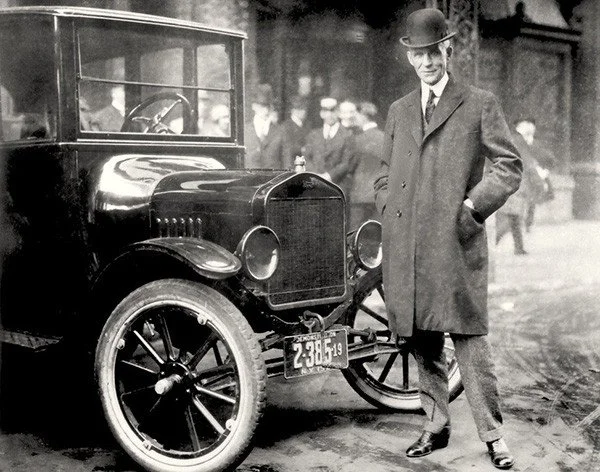
Henry Ford, with a Model T, in Buffalo, New York, 1921