Americans remember most presidents for their achievements: Washington establishing the national government, Lincoln winning the Civil War. But some chief executives are famous for their scandals. Abuse of power is not unique to America, but its effect on democratic government is especially damaging because they shake the foundation of trust in our nation’s highest office upon which our civil society is built. In this episode, we are going to look at three administrations marred by scandal (none of which included any living presidents). Each one involved corruption at the highest levels of American government, and all three reveal a truth about the nature of political scandals. They are not just about criminal behavior—the real lessons come from how our institutions respond to the abuse of government power.
Ulysses S. Grant: Corruption and Reform
On Inauguration Day in 1869, Ulysses S. Grant was probably the most respected man in the United States—or at least in the states that participated in the election. The Union Army under his command had preserved the nation amidst the fires of civil war, and his campaign promised a return to stability after nearly a decade of national upheaval. His inaugural message included language about affirming the rights of both Native Americans and recently-freed African Americans. Coming at a time when the United States was engaged in warfare on the Great Plains and struggling with rising segregationist tendencies, voters hoped he would put an end to these twin crises and restore peace and unity in the country.
Unfortunately, the vision Grant cast in his message to the nation could not match the forces of change pressing in on the national government. Its power was expanding rapidly as bureaucrats and military officials continued to occupy some Southern states, and mass industrialization was creating wealth and jobs but also opportunities for corruption and improper political influences. The civil service, a new and expanding part of the federal system, received little attention or oversight from Congress, and most jobs went to friends and political patrons rather than experienced professionals. Added to this were two aspects of President Grant’s personal character. Neither were flaws per se, and both had served him well on the battlefield. As a soldier, Grant was used to giving orders and being obeyed, but Congress and seasoned politicians had no problem bowing and scraping in the president’s office and then ignoring his instructions when they left the White House. Additionally, Grant was incredibly loyal to his friends, often to a fault. His past difficulties both inside and outside the military taught him to trust those whom he called friends, and when he put them in positions of power, that trust burned him more than once.
Early in his first term, two wealthy New York financiers, James Fisk and Jay Gould, befriended President Grant and parlayed their proximity to power into buying up gold at New York City banks. The two hoped to purchase enough gold to drive up the price and then sell it at an enormous profit. Other investors followed suit as gold values rose, sending the markets into a flurry of activity. President Grant took action in the following weeks by ordering the Treasury Department to release some of its gold holdings into the market—by adding to the gold supply, he hoped to cool down the price rise. But the result was a shock to the system that sent the price of gold plunging downward. Markets crashed on September 24, 1869, known as “Black Friday,” and thousands of investors, most of whom were farmers on the Great Plains, saw their financial futures wiped out. Investigations by the courts found Fisk, Gould, and others liable for the economic damage, and Grant was never proven to be corrupt, but the scandal led many in the public to believe that financial speculators were using their power in Washington to manipulate the markets. Three years later, the public learned of another abuse by the “robber-barons,” the Crédit Mobilier scandal. As American railroad companies built transcontinental lines, several firms billed the federal government for outrageous sums of money and allowed their executives to pocket the difference. The New York Times exposed this corruption in 1872, adding fuel to public outrage against the Grant administration (though the president again escaped personal blame).
The most damaging scandal of Grant’s presidency came in 1875 in an episode known as the “Whiskey Ring.” The federal government collected millions of dollars in liquor taxes, and distilleries across the nation often bribed politicians and Treasury Department officials to avoid paying these duties to increase their own profits. The Department of Justice opened an investigation and found that two officials within Grant’s inner circle, John MacDonald and Orville Babcock, were neck-deep in it. MacDonald had served with Grant in the war and been appointed a revenue collector in Missouri, and Babcock was the president’s private secretary. Grant told Attorney General Edwards Pierrepont, “Let no guilty man escape” and pledged to root out corruption in his administration. But when Babcock went to trial, the president instead defended his friend publicly and offered written testimony to the jury on his behalf (as did other senior Army officials like William Tecumseh Sherman). Babcock was acquitted on corruption charges, and the president’s efforts to stamp out these abuses of power faded as his second term reached its end. Sadly for President Grant, the Whiskey Ring scandal permanently damaged his reputation among the American people.
Historians generally agree that President Grant was not personally corrupt and that he never enriched himself with public money. But his style of leadership, that of giving commands without following up and trusting officials because of personal loyalty rather than proven honesty showed him to be a better general than chief executive. These scandals exposed the dangers of patronage in the civil service and forced Congress to take up reforms, culminating in the Pendleton Act of 1883 that required appointed civil servants to prove their competence through rigorous examination.
Warren Harding: Rampant Cronyism
The United States stood as a world power after the Allied victory in the Great War, but the American people were tired of foreign entanglements. President Wilson’s repeated calls for a League of Nations fell on deaf ears, and his chosen successor suffered a catastrophic electoral defeat in 1920 to the Republican Warren Harding. The new president had campaigned on a “return to normalcy,” which meant focusing on domestic affairs rather than trying to make the world safe for democracy, trade, or anything else. Harding had a wealth of political experience and personal charm, though his private life was messy to say the least—he regularly ignored the law on Prohibition and drank alcohol in the White House, and both contemporaries and historians allege that he fathered several children out of wedlock while serving as chief executive. Harding surrounded himself with political advisors from his home state of Ohio, dubbed by journalists at the time as the “Ohio Gang.” Like Grant, he favored loyalty over honesty, and he too would endure political scandal as a result.
One of the most important strategic natural resources in America was Teapot Dome, a distinctive rock formation in central Wyoming that gave its name to a vast oil field nearby. The government secured control of the land before the First World War, and in 1921, President Harding transferred ownership to the Department of the Interior. Interior Secretary Albert Fall, part of the “Ohio Gang,” would then select companies to drill for the oil and sell it to the Navy as fuel. Rather than seek competitive bids from major oil firms, Fall instead offered the contracts to his friends. In exchange, the owners gave the Interior Secretary a series of gifts and personal loans totaling $400,000 (over $7 million today). While the contract offers were legal—if questionable—the gifts and loans were not. Fall’s lavish spending in the year that followed caught the attention of journalists, who brought it to the United States Senate for an investigation.
The nation was outraged on reading newspaper accounts of how Fall had abused the public trust. The Senate opened an investigation in October 1923, and several senators involved won national acclaim for holding the corrupt officials to account and referring the matter to the Justice Department. In the end, Albert Fall became the first member of the Cabinet to be convicted of a crime and sent to prison. (Ironically, the court found him guilty on October 24, 1929, the “Black Thursday” that started the Great Depression.) Questions about what President Harding knew and when he knew it are familiar to students of presidential scandals. He had signed the executive order approving Fall’s contracts and, by 1923, was aware of growing corruption within his “Ohio Gang” inner circle. (He was also dealing with allegations that Attorney General Harry Daugherty was taking bribes from alcohol bootleggers, and his family recalled that these charges kept him up for many nights.) But history will likely never know the true extent of Harding’s involvement in or knowledge of Teapot Dome. The president suffered a fatal heart attack on August 2, 1923, two months before the official investigation began.
The Teapot Dome scandal was, until 1973, the most serious and public scandal in American presidential history. Harding’s successor, Calvin Coolidge, cooperated with the Senate investigation and appointed special prosecutors to pursue criminal charges; he also fired Attorney General Daugherty. But his small-government conservatism recoiled at public calls for greater transparency and regulatory reform, and meaningful laws to protect government funds from abuse of this sort only came in the 1950s and 1960s.
Richard Nixon: Watergate and a Constitutional Crisis
Nearly every presidential scandal since 1973 has been compared to Watergate—especially in the last decade. Whether the subject is arms shipments to foreign powers, private actions between consenting adults, dismissing government officials without cause, lying to the American people about a war, improper payments to third parties, alleged collaboration with foreign powers, or concealing the health of a presidential candidate, the “scandal metric” is always “is this worse than Watergate?” So what actually happened at the Watergate complex in Washington, DC? And before you get nervous, since this is close enough to recent history to stir partisan feelings, I’m going to do my best to avoid political commentary and just give you the facts.
Richard Nixon’s election in 1969 came at a time of social upheaval in the United States. War, the counterculture movement, nationwide protests and much more threatened the very fabric of American culture. Like every president, Nixon’s personality shaped his approach to the office, but in this case that meant a desire for personal authority and an unyielding distrust of everyone around him. By the time of his reelection campaign, Nixon could boast of several successes, but he worried that the Democrats might take the White House away from him. His reelection committee, the Committee to Re-Elect the President or “CREEP,” worked tirelessly to both boost his standing in the polls and dig up anything they could use against his opponents.
In June 1972, police arrested five men at the Watergate complex, which at the time housed the Democratic National Committee’s headquarters. The investigation soon connected the men to CREEP, but the White House dismissed early press reports about the growing scandal. The FBI then got involved, as did journalists Bob Woodward and Carl Bernstein of the Washington Post. When the story broke in 1973, after Nixon’s landslide victory in the election, the initial public reaction was somewhat muted. But in the weeks that followed, allegations (some later proven) of serious abuse of power by White House officials and CIA operatives trickled out of the administration and into the press. It seemed clear to many people, both in the public and in Washington, that a coverup was underway—now proven by unsealed records available to everyone. Like with Warren Harding and Teapot Dome, the question then became, “What did President Nixon know and when did he know it?”
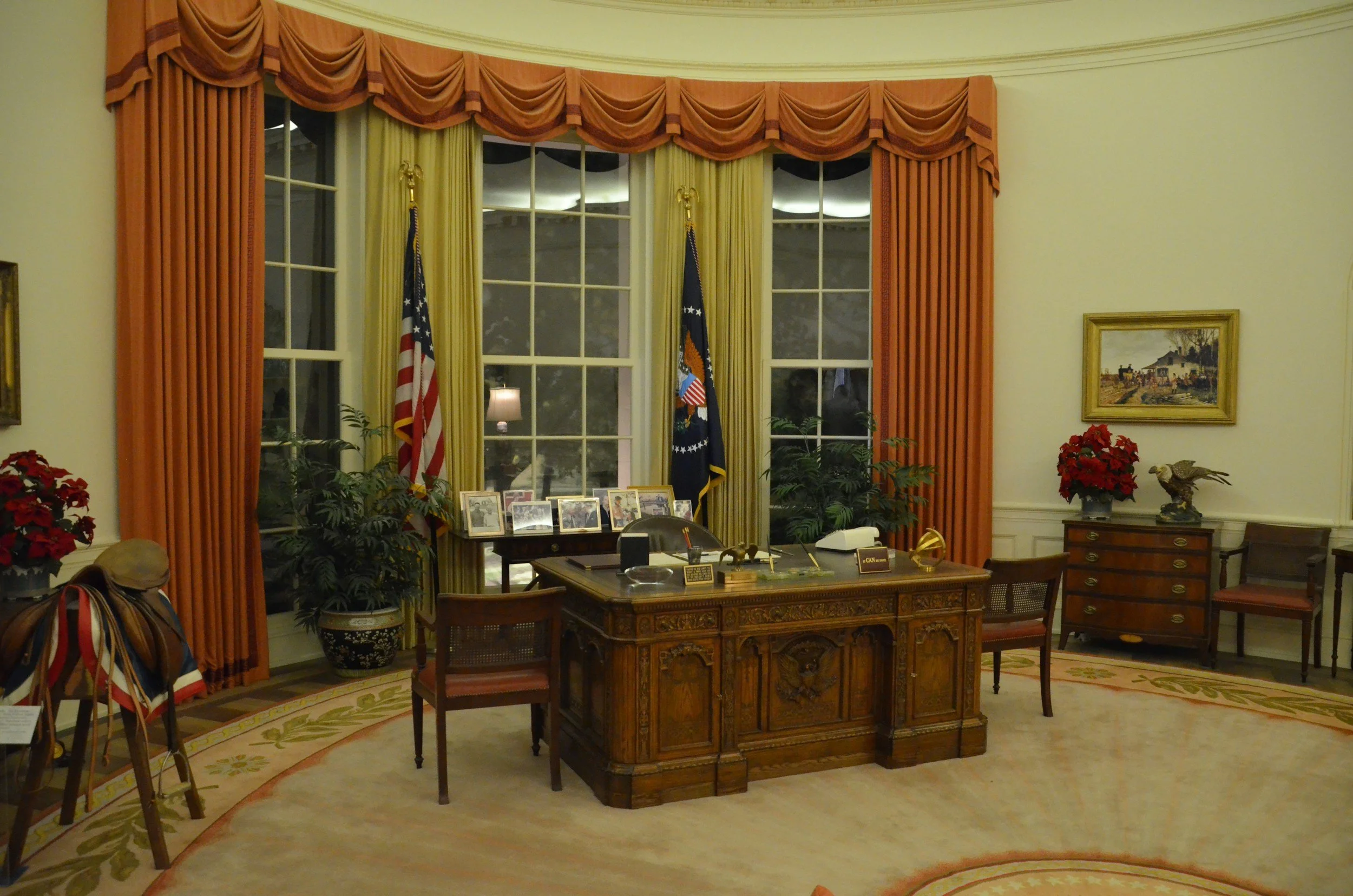
In July 1973, a former White House aide testified that Nixon had a secret taping system installed in the Oval Office. We now know that the president’s distrust of those around him had led to its installation, as he wished to have a permanent record of meetings and conversations that were not transcribed by a secretary. The entire conversation surrounding Watergate shifted immediately from “what did the president know?” to “what’s on those tapes?” Both Special Prosecutor Archibald Cox, whom Nixon had appointed, and the congressional select committee investigating the scandal subpoenaed the tapes, but the president refused to turn them over. He cited an implied constitutional provision known as “executive privilege,” that the president need not release information necessary to the exercise of his official duties. He then took the extraordinary step of ordering the attorney general to fire Special Prosecutor Cox. The AG refused and resigned his office. Nixon ordered his deputy to fire the prosecutor; he refused and resigned. Finally, the Solicitor General of the United States, Robert Bork, did the deed in what became known as the “Saturday Night Massacre.”
Across the nation, politicians and citizens alike howled that the president ought to be impeached and removed from office. Nixon spiraled into a deep depression and sought solace in drink, leaving the nation basically ungoverned for entire days at pivotal moments in the Cold War. Some tapes were eventually released, including two with missing gaps in the recordings, leading to renewed outrage at the president. As the investigations closed in around Nixon, he continued to protest his innocence and that he was “not a crook.” Congress opened formal impeachment proceedings in May 1974, and the Supreme Court ruled in July that all tapes be released since executive privilege did not cover material that was “demonstrably relevant in a criminal trial.”
The last days of the Nixon administration were drama worth more than one Hollywood feature. The House of Representatives’ Judiciary Committee recommended articles of impeachment on July 27th, and the White House released a tape nine days later with clear evidence that the president had lied to the nation about his knowledge of the coverup and had been involved in it from the beginning. On August 5th, two future presidents of the United States, Governor Ronald Reagan of California and Republican National Committee Chairman George Bush both urged Nixon to resign. Congressional support for the president evaporated—he would be impeached and then, in all likelihood, removed from office. President Nixon spoke to the nation on August 7th and announced that he would resign his office the following day. He departed the White House the next morning, flashed his signature double-V sign to the photographers, and left for his home in California.
Whatever one thinks about the events surrounding Watergate—and for the sake of time I’ve had to leave quite a bit out—the historic moment of a president resigning his office rather than fighting on is, I believe, a testament to the enduring structure of America’s constitutional system. There were no tanks on the streets, no soldiers in riot gear ready to use force to keep the president in office or else battle his supporters. The courts found that the president is not above the law, the Congress began the process to remove him and punish him for his crimes, and the president acknowledged that he was finished. Though many believe our system’s foundations trembled, they held (and still hold today).
The scandals that rocked the American presidency were not unique to history, nor was the corruption that burned in men’s hearts. What makes them significant today is how our system responded. Grant’s presidency accelerated the movement toward civil service reform and ensuring our leaders are competent. Harding’s eventually gave us the ability to scrutinize the details of government finance. And Nixon’s shaped our attitude toward executive power and reaffirmed the truth that the president is the servant of the people. For students of history, these scandals offer important reminders. Power must be monitored. Trust must be earned. And institutions must be independent. No man is above the law in a constitutional system. And though scandal reveals weakness, accountability reveals strength. That tension between power and the principles that undergird it remain central to the American experiment.