Sketches in History | The Secret at Teapot Dome
Hello, and welcome back to Sketches in History! I’m Lottie Archer, your guide. Every week, we sit in my grandfather’s study and open my magical notebook to a sketch from history, letting it pull us into the past to experience a moment first-hand. Last time, we experienced the passing of several amendments during a time of change in the United States. The notebook really took us on a journey. I can’t wait to see where it takes us today!
There’s a fire burning in the hearth tonight, and the study has that familiar smell of old books and polished wood. My grandfather’s shelves are full of old, historical pieces from across the ages, but in the dim light, sometimes I can only see the reflection of the fire or lamp off their surfaces. There is something though, that stands out tonight, on the fourth shelf down from the top. Let’s go over and see what it is. It’s a small glass bottle filled with dark, thick liquid (something that smells earthy and heavy, almost like tar). I think it’s oil! Beside it is a folded newspaper with a headline barely visible in the firelight: SENATE CALLS FOR INVESTIGATION. Tucked under both of them is a worn leather coin pouch. It’s small; so small it can be concealed in one’s hand.
What happened that made the Senate take notice? And what does this bottle of oil have to do with it? Let’s see what the notebook has to show us.
But first, our word of the day: Integrity. Have you ever been left in charge of something that didn’t belong to you (maybe a friend’s toy, or something important someone trusted you to carry) and you took care of it honestly, exactly the way you’d want someone to care for something of yours? That’s integrity. It means doing the right thing even when no one is watching. It means being honest, moral, and doing things according to a principle. Integrity is what makes a person trustworthy, and when someone in a position of power has integrity, they use that power to serve others rather than to help themselves.
We open the sketchbook to a page that shows a wide, open Wyoming landscape under a pale blue sky. In the middle of it all, rising from the flat plains, is a rock formation that looks unmistakably like a teapot (spout, lid, and all). Around it, tall wooden oil derricks stretch toward the sky, and down below, two men in suits stand beside a sleek black automobile. One man is grinning. The other is slipping something into his coat pocket.
The oil derricks begin to turn. A dry wind stirs across the page. I can smell that same thick, tarry scent from the bottle on the shelf; stronger now, and very real. The dust on the sketch begins to lift.
Are you ready? Close your eyes, hold on tight, and let’s go!
We made it! We’re standing on wide, flat prairie under an enormous sky. The air is dry and warm, and that smell (oil, deep and ancient) is everywhere. In the distance, I can see the teapot-shaped rock formation. It really does look just like a teapot! And all around us, tall wooden towers loom over the ground. These are oil derricks, drilling deep into the earth to pull up the thick black liquid that powers ships, machines, and engines. On a table near one of the derricks is a newspaper with a rock on it so it doesn’t blow away. Let’s check the date…its 1922 and according to the paper, we’re in Wyoming!
There’s a notice on one of the derricks, and when we look at the others, we can see that the same notice is on all of those as well. The notice tells us that the oil these derricks is pumping belongs to the United States Navy. It seems like the government set aside these oil fields years ago so that Navy ships would always have fuel in an emergency. It’s not private oil; it’s the Navy’s oil, held in trust for the protection of the whole country.
Two men are walking toward the black automobile parked near the nearest derrick. I recognize one of them to be Albert Fall, the Secretary of the Interior, one of the most powerful cabinet members in Washington, D.C. at this time. President Warren Harding appointed him to help manage the nation’s natural resources. The president trusted him. The country trusted him.
The other man is a wealthy oil businessman, nodding eagerly as Fall speaks.
“The contract is yours. Drill it, sell it, and the Navy will buy the fuel. No open bidding; no competition. Just between us.”
The businessman opens a leather satchel and hands Fall a heavy bundle wrapped in cloth. Fall tucks it quickly inside his coat. I feel a knot in my stomach. I think Fall just gave away something that belonged to all Americans (the nation’s emergency oil reserves) to a private company, without following the rules. No fair, market competition. No open process. Just a secret deal. And in exchange, it looks like he’s being paid personally.
The notebook’s pages start to shift. Let’s see where it takes us next.
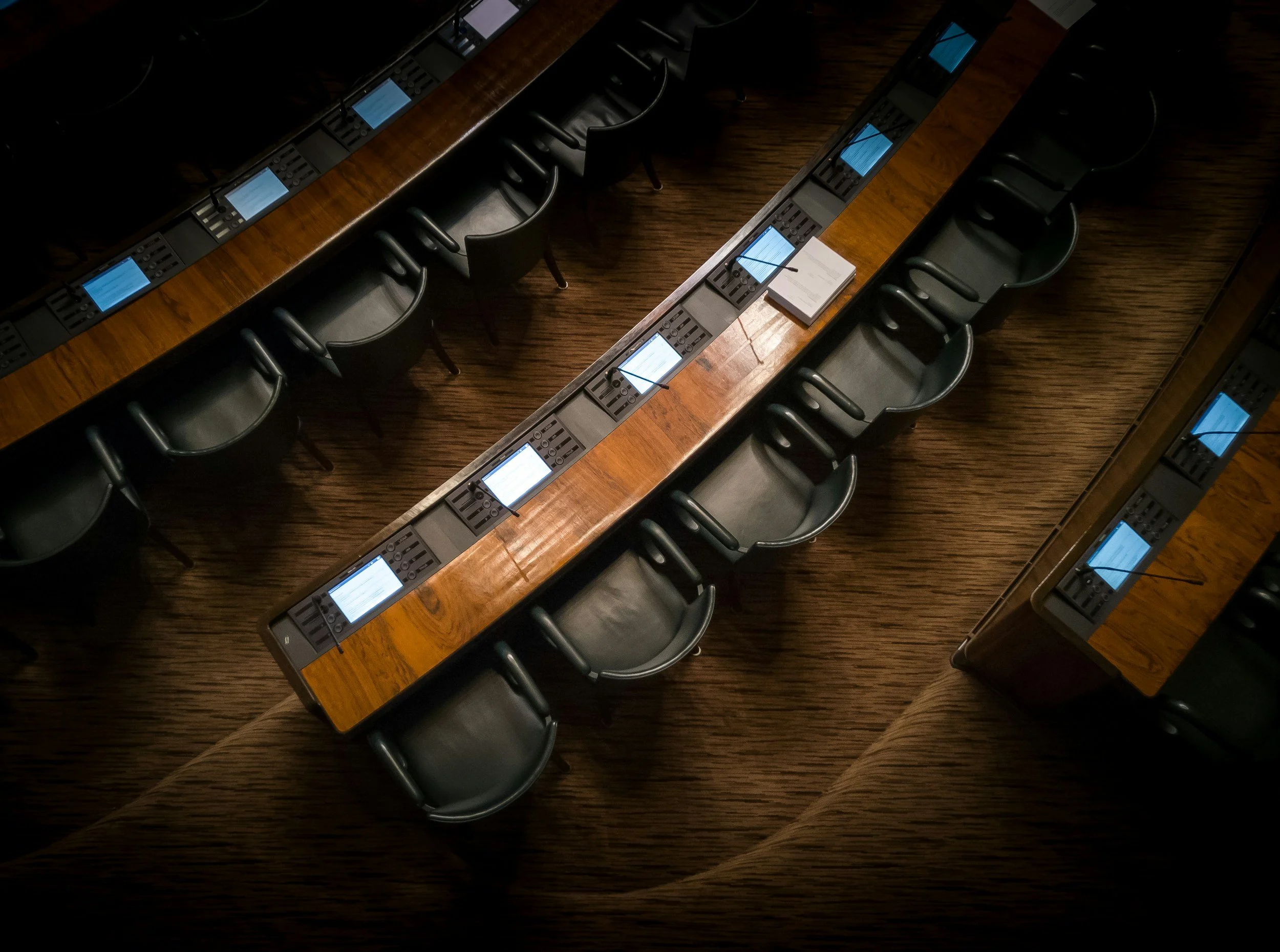
The Wyoming plains have dissolved, and now we’re standing in a tall, echoing chamber in Washington, D.C. This is a United States Senate hearing room. Rows of senators sit at long curved desks, papers spread before them. Reporters crowd the gallery above, pencils ready. In the center of the room, sitting alone at a small table, is Albert Fall.
He doesn’t look nearly as confident as he did out in Wyoming.
Senator Thomas Walsh of Montana leans forward, calm but direct. He has been working on this investigation for over a year; reading through thousands of pages of records, following every dollar, asking questions that powerful people did not want to answer. He is not angry. He doesn't need to be. The facts are enough.
"Mr. Fall, the evidence before this committee shows that you received personal payments totaling hundreds of thousands of dollars from the very oil companies that received these government contracts. Can you explain that to the American people?"
The room is very quiet. Every reporter in the gallery is holding a pencil. Every senator is leaning forward.
Fall shifts in his seat. He looks smaller than he did out in Wyoming. He had told people the money was just a personal loan from a friend, nothing unusual, nothing improper. But the Senate had been digging for months, reading bank records, interviewing witnesses, following the money from one hand to the next. I can see some of the evidence on one of the tables. Fall made more deals, collecting hundreds of thousands of dollars in personal gifts and loans from oil companies in exchange for contracts that should have gone through a fair, public process. With that money, he renovated his ranch in New Mexico. He bought new cattle and expensive equipment. And people start to notice. The more questions they ask him, the more his story doesn’t hold up. It’s coming apart, piece by piece, right here in this room. Fall has no good answer. And he knows it. He knows that Walsh knows it. And he knows that every reporter in that gallery is about to tell the whole country.
I have a feeling this isn't the end. From what I've read in my grandfather's books, this investigation is going to go on for a long time after today; more witnesses, more documents, more questions that Fall won't want to answer. The journalists aren't going to let this go. And neither, it seems, is Senator Walsh. I think the notebook will tell us how this ends, but I know that for now, the people asking the questions are not going to stop. The system is working, even when it's slow, even when it's hard.
The system has held. It isn't fast, and it’s not easy. Reporters have to be willing to keep asking questions, Senators have to stay in their seats and do the hard, unglamorous work of reading through stacks of financial records, and the courts have to be willing to follow the evidence wherever it leads. But it’s being put into action. Honest people, doing honest work, made sure that power didn't go unchecked. People practicing integrity.
I think its time we got back to the study.
The hearing room fades, the voices grow quiet, and the warm light of grandfather’s study wraps around us again. The notebook settles closed on the desk. The little glass bottle of oil sits in the firelight, ordinary now, but carrying its big story. Let’s see what the notebook has to tell us about what we just saw.
We just experienced one of the most famous political scandals in American history: the Teapot Dome scandal of 1921 to 1924. Albert Fall, Secretary of the Interior under President Warren Harding, secretly transferred control of government oil reserves (including the field near the famous teapot-shaped rock in Wyoming) to private oil companies in exchange for personal payments. He had taken something that belonged to the United States Navy and sold it for personal gain. The Senate investigation, led by Senator Thomas Walsh, exposed the scheme, and when it was finally over, the verdict was clear: Fall was convicted of bribery in 1929, becoming the first cabinet member in history to be imprisoned for crimes committed while in office. President Harding died before the full investigation was complete, so history has never fully determined what he knew. But the scandal reminded the country of something important: public trust is not a privilege to be sold. It is a responsibility to be honored.
Remember our Word of the Day? That’s right: integrity. Albert Fall was trusted with some of the most important responsibilities in the American government. He had real power. And he used it to help himself instead of the people he was supposed to serve. That’s the opposite of integrity. The people who did have integrity (Senator Walsh who kept asking questions, the journalists who kept reporting, the courts that followed the evidence) made sure that power didn’t go unchecked. They showed us that honest people doing honest work can hold even the most powerful officials accountable. Power must be earned with honesty. And when it isn’t, the truth has a way of coming out.
Senator Walsh once told his colleagues: “The fact that practices may be common does not make them right.” He was right. He kept asking questions. He kept pursuing the truth. And when the evidence proved the crime, he sought justice. That made all the difference.
Thank you for joining me for another Sketches in History! Don’t forget to subscribe to the 15-Minute History Podcast so you won’t miss a single journey. And if there’s a moment in history you’d love to explore with me, send your ideas to 15minutehistory@gmail.com.
Until next time, keep wondering, keep imagining, and remember... the past is just a page away.
Discussion Questions
Why do you think it was so important that the Senate investigated Albert Fall, even when it was uncomfortable and took a long time?
Have you ever been trusted to take care of something that belonged to someone else? What does it feel like to be trusted that way?
Albert Fall had a lot of power. Why do you think having power makes integrity even more important, not less?
Senator Walsh said, “The fact that practices may be common does not make them right.” What do you think that means? Can you think of an example from your own life?
The oil in the ground at Teapot Dome belonged to everyone in America. Why does it matter who is in charge of things that belong to the public?