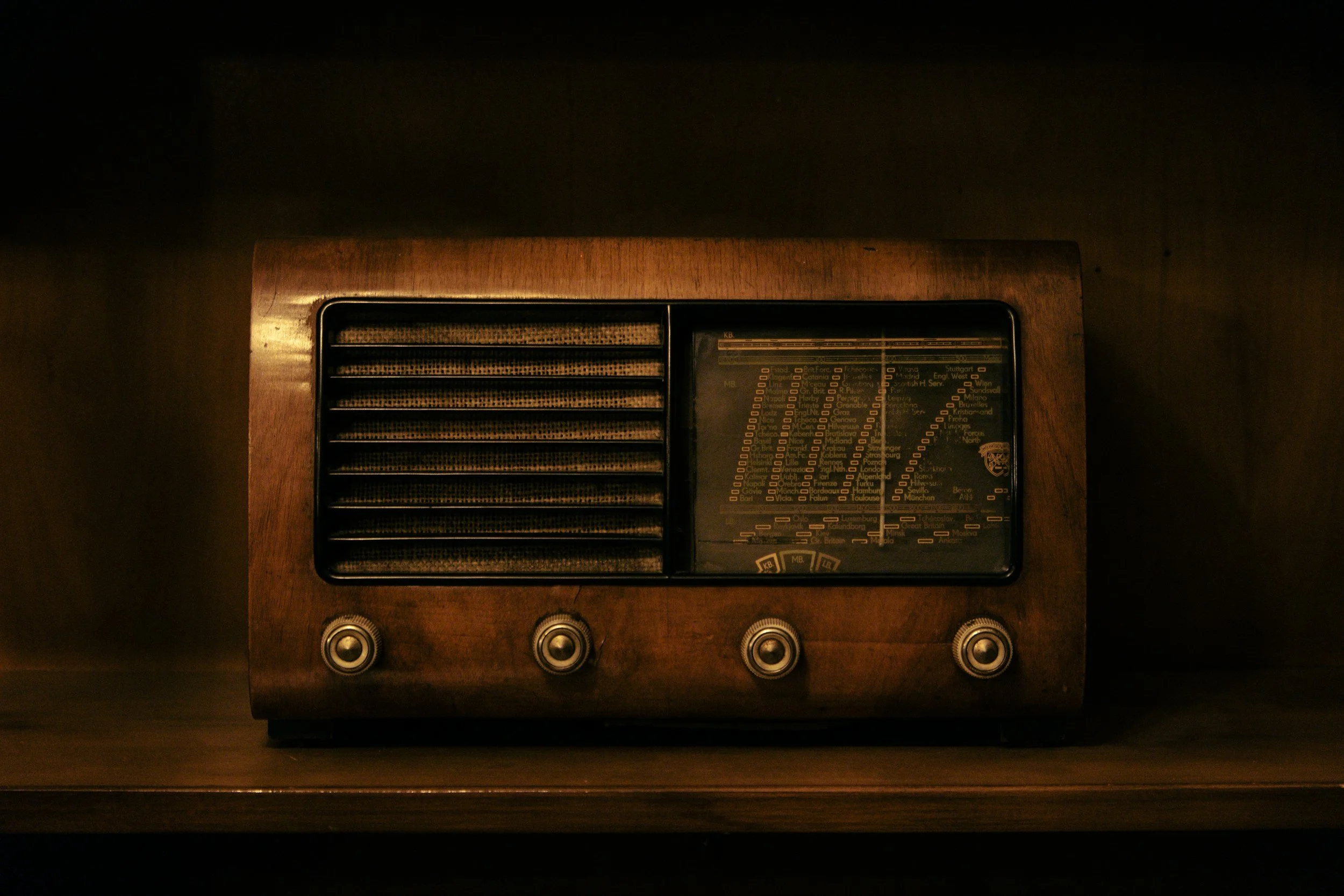
Sketches in History | This Sunday. Ten O'Clock. The President Speaks.
Hello, and welcome back to Sketches in History! I’m Lottie Archer, your guide. Every week, we sit together in my grandfather’s study and open my magical notebook to a sketch from history, letting it pull us into the past to experience a moment first-hand. Last time, we watched a daring senator pull apart a secret oil deal in the Wyoming hills. I can’t wait to see where we go today!
It’s a quiet evening in the study. Its raining outside, and I can hear the drops hitting the window. The fire is going and the curtains are drawn, and everything feels cozy and still. But as I walk toward the shelves, something catches my eye. Do you see it? It’s a microphone. An old one. It is made of a chrome metal. The wires that once connected it to recording equipment are wrapped around its base. The surface is smooth and cold. Tucked underneath it, barely visible, is a small folded card. Let’s pick it up.
The handwriting is hurried, like someone wrote it quickly. It says: “This Sunday. 10 o’clock. The President speaks. Don’t miss it.” That’s all. No explanation. No date. Just those four short lines. I have a feeling the notebook is going to show us what this is.
But first, let’s learn our Word of the Day: persuade. To persuade someone means to use your words to change the way they think or feel, to help them trust something, believe something, or do something they might not have done otherwise. A great teacher persuades you that a hard subject is worth learning. A good friend persuades you to try something scary. And as we’re about to see, one president persuaded millions of frightened Americans to take a very brave step, just by talking to them honestly.
Alright. Let’s see what the notebook has to show us.
The sketch fills the whole page. It shows a man sitting in front of three microphones, just like the one on my grandfather’s shelf. He is leaning forward over the mics, with papers in front of him. A lamp is on the corner of his desk. Wires crisscross over the floor. Outside the sketched window, there are bare trees and darkness. The desk lamp begins to flicker and glow.
Are you ready? Close your eyes, hold on tight, and let’s go!
We made it!
We’re standing in the small room, with lights surrounding a desk in the center. Outside, I can see the wind blowing against the trees. Snow is on the ground. Based on what I see, I think we’re in the White House! Lets find a spot to hide and watch what the notebook whats to show us.
The room we’re in is smaller than you might think. It’s called the Diplomatic Reception Room, and tonight it has been set up very carefully. There’s a single wooden desk under a warm lamp, and on the desk, three microphones stand in a neat row, one for CBS, one for NBC, one for the Mutual Broadcasting System. A man in a vest is adjusting a cable on the floor. Another is checking the clock on the wall.
The room smells of smoke and old paper.
President Franklin Roosevelt wheels in. He moves carefully, the way he always does. A disease called polio took the use of his legs when he was thirty-nine years old. He wears heavy metal braces and usually needs the arm of an aide to stand. But tonight he rolls his wheelchair right up to the desk, settles in, and picks up the pages in front of him.
He looks at the microphones. Then he does something unexpected. He smiles. Not a big, formal smile. A small one, like he’s about to sit down with someone he genuinely likes.
A technician holds up three fingers. Two. One.
That’s how it starts. Just: I want to talk with you.
We are in the year 1933, and the United States is in the middle of something called the Great Depression. Millions of people have lost their jobs. Thousands of banks have closed, and families who had saved their whole lives have lost everything. People are frightened in a way that’s hard to describe. No one in our time has ever experienced something like the Great Depression. Everyone in the country is afraid.
Now listen to how the President is speaking. He isn’t performing. He isn’t using big complicated words. He’s explaining, calmly and clearly, what happened to the banks and exactly what his plan is to fix it. He says “my friends” at the start, like he means it. And right now, in living rooms all over the country, people are hearing that voice. Farmers in Nebraska. Factory workers in Ohio. A mother in Georgia who has been hiding her last twelve dollars in a coffee tin above the stove because she’s too afraid to trust a bank with it. They’re all hearing the same voice, at the same moment. And something about that, the shared experience of it, matters just as much as the words.
One of the technicians is watching a stack of notes near the door. A man keeps leaning in to hand him paper slips. I can just make out what’s on them: numbers. Telephone switchboard tallies. Across the country, operators are reporting that callers are keeping their lines open just to hear the broadcast. Restaurants have gone quiet. Movie theaters have stopped their shows and turned on their radios.
The President is still speaking. He’s explaining that the banks will reopen tomorrow, that the government has checked them, and that the ones opening their doors are safe.
There’s quiet in the room. Even the technicians have stopped moving. He speaks for about fourteen minutes total. No thunder, no drama. Just a man explaining a hard thing honestly. Then he says good night, and the microphones go dark.
The technician in the vest lets out a long breath. Someone near the door starts clapping softly. The President gathers his papers. And then he’s gone.
A new sketch is forming, and this one is different. Two men stand at podiums on a stage. Behind them, a plain gray curtain. Above them, studio lights so bright you could probably feel them from here. There is a clock on the wall next to the date. It shows the year is September 26, 1960. The dirt on the drawing begins to shift. The studio lights begin to glow. Let's go!
We made it! Oh, it is bright in here. Bright and cold, the way television studios always are. The lights overhead are enormous and hot, even though the room itself is being kept cold on purpose to stop the cameras from overheating. I can hear technicians talking in low voices somewhere behind us. Let's find somewhere to watch. Over here, behind the camera equipment.
There are two men at the podiums. The one on the left is Senator John Kennedy. He is thirty-three years old, tanned from a week in Florida, and wearing a dark suit that looks almost black on camera. He isn't gripping his podium. He isn't shuffling his notes. He's just standing there, relaxed and still, like he's been waiting comfortably for this moment his whole life. When a technician adjusts a cable near his feet, Kennedy glances down, smiles briefly, and looks back up. Completely at ease.
The one on the right is Vice President Richard Nixon. He arrived tonight having just finished two straight weeks of campaigning across all fifty states. He lost fifteen pounds from a knee infection that put him in the hospital last month, and you can see it in his face, the hollows under his cheekbones, the gray under his eyes. Someone offered him makeup before the broadcast and he said no. Under these studio lights, a five o'clock shadow on a pale face reads very differently than it does in person.
Now watch Kennedy. When the moderator asks the first question, Kennedy turns toward the camera, not the moderator, and not Nixon. He speaks directly into the lens, like he's talking to one single person sitting at home. His voice is calm. His hands are still. When he finishes his answer, he simply stops speaking, folds his hands, and waits. No fidgeting. No looking around.
Nixon answers next. He's sharp. He knows his facts. He actually wins the argument on several points if you're listening carefully for the details. But he's sweating under the lights now, just slightly, and he keeps glancing over at Kennedy.
The camera is not grading this the way a debate judge would. It isn't measuring who has the better argument. It is measuring something harder to describe: who looks like they belong here. Who looks like they're not afraid.
Seventy million Americans are watching this on television right now. And out there, in living rooms across the country, something is shifting that no newspaper headline will fully be able to explain. Millions of people are making up their minds, and they're doing it quietly, almost without realizing it, simply by watching two men stand still under bright lights.
Elsewhere tonight, millions more are following along on the radio. And here is the strangest part. When those listeners are surveyed afterward, most of them will say Nixon won. The radio audience heard a sharp, experienced debater who knew his subject cold.
The television audience saw something else entirely.
The same debate. Two completely different contests. Depending on which machine you used to watch it.
Let’s flip to the pages that brought us here and get back to the study.
We made it back! The fire is still going and the study is warm and quiet. The old microphone sits on the shelf exactly where we found it.
But now there’s something else on the desk that wasn’t there before: a stack of envelopes. Dozens of them, maybe more. I pick one up. The return address says Dayton, Ohio. Another says Burlington, Vermont. Another says a town I’ve never heard of in Mississippi.
I open one. It’s a letter addressed to President Roosevelt. The handwriting is careful, like the person wanted to make sure they got every word right.
“Dear Mr. President. I listened to you last night on the radio. I had been afraid. But after you spoke, I went first thing this morning and put my money back in the bank. I trust you. I believe we are going to be all right. I am going to deposit my money into a bank tomorrow.”
After the first Fireside Chat, over half a million letters arrived at the White House in a single week. Not because a law told people to write. Not because a newspaper told them what to think. But because a man had spoken to them honestly, right in their own living rooms, and they believed him. He would give around thirty Fireside Chats over the next twelve years. Through the worst of the Depression. Through the long years of World War II. And every single time, the idea was the same: I’m going to talk to you like a neighbor. I’m going to tell you the truth. And I believe you can handle it.
Remember our word of the day? That's right: persuade. Today we saw what real persuasion looks like, and we saw it twice. Franklin Roosevelt persuaded millions of frightened Americans to trust the banking system again, not with a new law, not with a threat, but by sitting down at a microphone and speaking to them honestly, right in their own homes. Half a million people picked up a pen and wrote back to say they believed him. Then, nearly thirty years later, John Kennedy stood under the brightest lights in the country, in front of seventy million people, and persuaded them of something without saying a single word about it. He persuaded them simply by the way he stood. The way he was still. The way he looked straight into the camera like he had nothing to hide and nowhere else he'd rather be. Two men. Two very different mediums.
The first Fireside Chat, broadcast on March 12, 1933, marked a turning point in how American presidents communicate with the public. In the depths of the Great Depression, President Franklin D. Roosevelt used the radio not as a stage for formal speeches, but as a tool for direct, personal conversation with ordinary Americans. Speaking in plain language about the banking crisis, Roosevelt explained his Emergency Banking Act and asked citizens to return their savings to newly inspected banks. The response was immediate: Americans began depositing money the very next morning, and over 500,000 letters arrived at the White House that week. Roosevelt would deliver approximately 30 Fireside Chats between 1933 and 1944, covering topics from unemployment to wartime strategy. Nearly three decades later, on September 26, 1960, the arrival of television introduced an entirely new dimension to presidential communication. The first televised presidential debate between Senator John F. Kennedy and Vice President Richard Nixon drew 70 million viewers. Surveys taken afterward revealed a striking divide: radio listeners largely believed Nixon had won on the strength of his arguments, while television viewers believed Kennedy had won by a wide margin. The difference was not what the two men said, but how they appeared saying it. Kennedy, rested and at ease before the camera, projected a calm confidence that translated powerfully on screen. Nixon, exhausted from weeks of campaigning and visibly uncomfortable under the studio lights, struggled with a medium that rewarded presence over precision. Together, the Fireside Chats and the 1960 debate illustrate the same truth from two different eras: the medium a president uses to reach the people does not just carry the message. It shapes the message, and sometimes, it decides who is believed.
Thank you for joining me on Sketches in History! Don’t forget to subscribe to the 15-Minute History Podcast so you won’t miss a single journey. And if there’s a moment in history you’d love to explore with me, send your ideas to 15minutehistory@gmail.com.
Until next time, keep wondering, keep imagining, and remember… the past is just a page away.
Discussion Questions
President Roosevelt chose to speak on the radio like a neighbor at the kitchen table instead of giving a formal speech. Why do you think that made people trust him more?
After the Fireside Chat, over half a million people wrote letters to the White House. What does that tell you about what happens when a leader treats people as equals?
Seventy million Americans watched the Kennedy-Nixon debate on television, and millions more listened on the radio. The radio listeners thought Nixon won. The television viewers thought Kennedy won. How is it possible that the same debate had two completely different results?
The camera wasn't measuring who had the better argument that night. It was measuring something harder to describe. What do you think it was measuring? Is that fair?
Roosevelt used the radio to reach people. Kennedy used the television. What medium do leaders use today to speak directly to people? Do you think it makes them more honest, or less?